The Story of Cognigy
Cognigy builds an enterprise AI agent platform for customer service and contact centers.
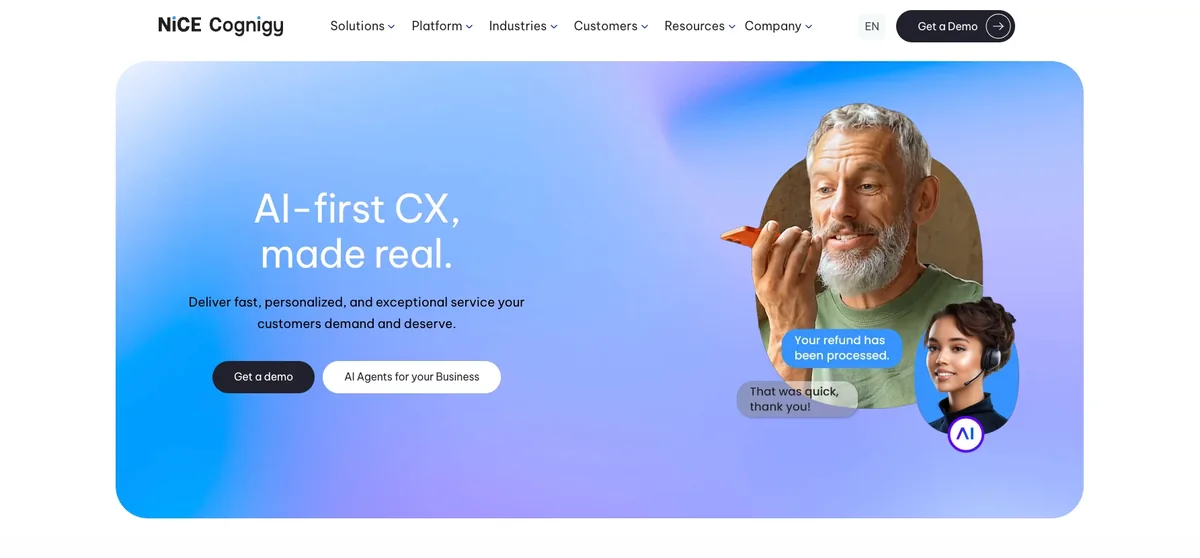
Its customers are large enterprises automating conversations with their own customers.
The brand was well known, and branded search was healthy. But Cognigy wanted more qualified leads, and that meant reaching buyers who were researching AI agents and conversational AI, not searching for Cognigy by name.
The goal was simple: grow qualified leads from non-branded SEO traffic.
Cognigy brought me in at the end of 2023 to make it happen.
The Challenge: Growing Beyond Branded Search
Cognigy’s pages were appearing in Google for the topics buyers searched for. They just weren’t ranking well enough to get the clicks.
The analysis found four reasons:
- Pages competing with each other - For core topics like conversational AI, Google ranked several different Cognigy pages for the same keyword. It couldn’t tell which one was the best answer.
- Internal links pointing the wrong way - Most internal linking flowed to the solution and platform pages. The blog and resource content, which was needed to rank for informational searches, got far fewer links and unclear anchor text.
- Everything looked equally important - Almost every page sat two clicks from the homepage, because everything was linked from the main navigation and blog listing pages linked to every post.
- Content falling out of date - A lot of the content was a few years old, in a market where AI changes every few months. Some topics had two similar posts competing for the same search.
At the same time, competitors were investing heavily in content hubs, and some of the biggest names in software were launching their own AI agents.
Cognigy had the authority to compete. Its website wasn’t letting it.
The Approach: Build on the Brand, Then Win the Topics
Most SEO strategies start with high-volume, highly competitive “what is” content. I didn’t want to start there.
Cognigy’s brand was its biggest asset. So the work started with consideration-stage searches, where Cognigy’s solution pages already ranked but just outside the top spots. Then it moved on to the bigger awareness topics.
The work ran in two phases:
- Fix the foundations - Optimise the existing pages, clean up the content and fix the website architecture.
- Build for growth - Launch content hubs for competitive topics, then invest in the content competitors couldn’t copy.
Each phase had its own SEO strategy, business case and impact model, so the team knew what to invest in and why.
Growing Non-Branded Traffic: How I Built the SEO Strategy
I worked with Cognigy’s marketing, content, product and development teams to grow non-branded SEO traffic.
1. Optimised the solution pages for striking-distance keywords
The fastest wins were keywords Cognigy already ranked for, just not high enough.
I ran keyword research and clustering to map every solution, industry and platform page to the topic buyers actually searched for. Pages like AI agents for insurance or healthcare were matched to their non-branded keywords.
Each page then got new title tags, H1s and meta descriptions, plus content briefs for the content team.
2. Cleaned up the content
Old and duplicate content was holding the rest of the site back.
A content audit identified low-value pages to remove, redirect or combine. Similar posts on the same topic were merged into one stronger page, so Google had one clear page to rank.
I also introduced a freshness distance metric: the gap between when a Cognigy page was last updated and when the freshest competing page was. Reviewing it every 3 to 6 months became part of content planning.
In AI, a post that’s a year old can already be out of date.
3. Fixed the website architecture and internal linking
Google needed clear signals about which pages mattered most.
- More links to the content that needed to rank - Related content lists and link modules at the start and end of articles pointed to key blog and resource pages.
- Better anchor text - An anchor text audit set an exact-match keyword and natural variations for each important page.
- A clearer hierarchy - I worked with the developers on how the blog listing pages loaded links and which pages belonged in the main navigation.
- A repeatable process - The team was trained to add internal links as part of every new piece of content.
4. Built content hubs for competitive topics
For the biggest topics, like AI agents and conversational AI, one page was never going to be enough.
I designed topic clusters to cover each topic in full:
- Pillar page - Covers the core topic in depth.
- Cluster content - Answers the long-tail questions buyers ask.
- Internal links - Connect the cluster content back to the pillar.
Each hub sat in its own URL folder, with a new pillar page template, linked from the main navigation so it was only one click from the homepage.
5. Streamlined the content process
Great content doesn’t help if it’s stuck waiting for approval.
I reviewed the content workflow with the team and recommended fewer review steps, so content could be published at least once a month. Product and content still worked together, but without the bottlenecks.
Published content was also reviewed and updated as the market moved, adding new topics like agentic AI to older articles.
6. Set out the next growth levers
The second strategy focused on content competitors couldn’t copy:
- Reviews and case studies - Capture more customer reviews on third-party platforms, then turn happy customers into public case studies.
- Real-world examples - Searches for AI agent use cases and examples reward pages with lots of specific examples. Cognigy’s own customer stories could supply them.
- Original research - An annual report built on survey data, turned into data-led articles that earn links naturally.
- Interactive content - An ROI calculator, an AI agent demo page and a crawlable integrations section. The existing integrations marketplace loaded its listings with URL fragments, which Google can’t index.
- A contact center content hub - Content on why investing in contact centers and customer experience pays off.
7. Reported on what mattered
Weekly SEO reporting split branded and non-branded traffic, so the team could see the growth that mattered rather than brand demand.
It tracked rankings by keyword group, flagged changes in Google like AI Overviews, and connected SEO traffic to leads.
The Results: Non-Branded Organic Traffic Doubled
According to Ahrefs, Cognigy’s average non-branded organic traffic grew from around 1,100 when the work started in late 2023 to around 2,400 by July 2026.
That’s 2x the non-branded traffic, for key moments in the buyer’s journey where Cognigy wasn’t appearing in Google Search.
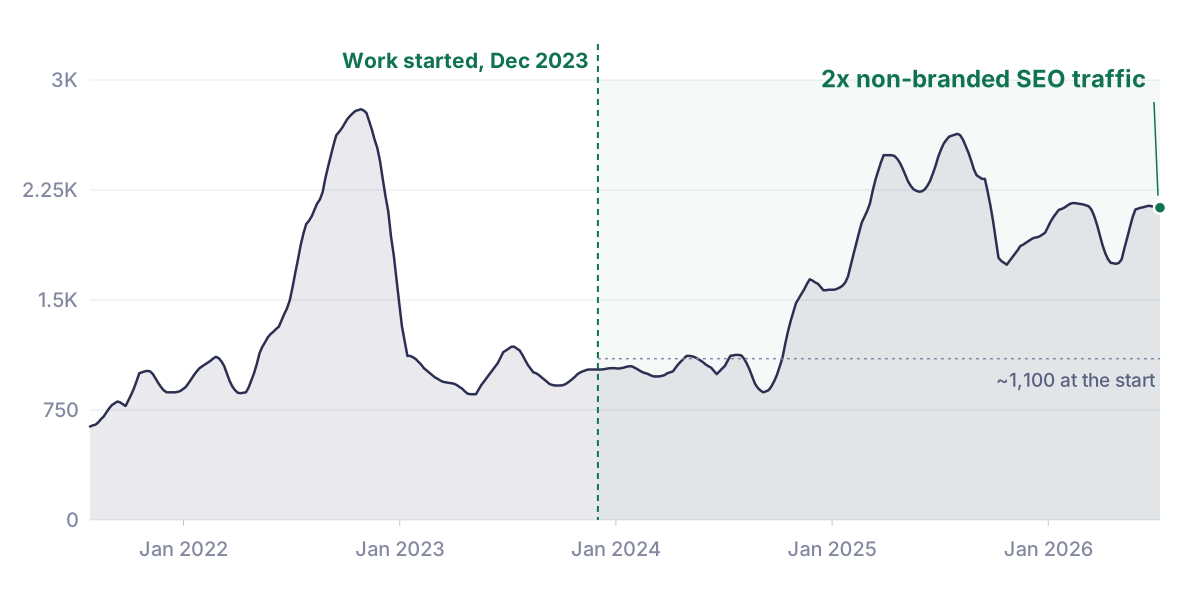
The foundations took time. Non-branded traffic started to climb in early 2025 and has stayed well above where it started ever since.
That’s the difference between a traffic spike and a channel.
