The Story of Rangewell
Rangewell is a UK business finance platform. It helps businesses find and apply for funding, from commercial mortgages to asset finance.
SEO is a core acquisition channel. Every organic visitor is a potential finance application.
Rangewell wanted to grow SEO traffic and leads in three areas: business finance, professional services and commercial property finance.
I worked with Rangewell’s product, engineering and content teams to make that happen.
The Challenge: Decline in SEO Traffic for the Website
UK SEO traffic declined between October 2020 and December 2021. The drops lined up with Google core updates.
Google’s advice after a core update is to improve content quality and user experience. Rangewell needed to know where its quality problems were.
The analysis found four:
- Too many pages. Rangewell had 1,300 indexable pages. A direct competitor had 210 pages and 10x more UK SEO traffic.
- A bloated navigation. The main navigation carried 497 internal links. The same competitor used 55. Every page looked equally important, so none of them did.
- Pages competing with each other. SERP analysis found 26 pages targeting keywords Google treats as the same search. “Asset finance” and “what is asset finance” return the same results, but Rangewell had separate pages for both.
- Content in silos. Landing pages, guides and case studies on the same topic sat in different folders. Commercial property content was split across /finance-options/ and /article/.
Google couldn’t work out the site’s hierarchy. As John Mueller put it, with everything interlinked Google “can’t figure out which one is the most important one.”
More content wasn’t going to fix that. Better structure would.
The Approach: A Focus on Quality Grouped into Hubs
The plan was to make the website smaller and clearer, then fill it with high-quality content.
That meant three strategic initiatives:
- Reduce the size of the website. Remove, redirect or combine low-value and duplicate pages.
- Reduce the size of the navigation. Under 100 links, pointing only to the important pages.
- Publish content into content hubs. Group every landing page, guide and case study on a topic under one hub.
The keyword research shaped where to focus. Short-tail business finance topics had 100x the search demand but far more competition. Long-tail sector topics had less demand, less competition, and only needed one or two in-depth pages each.
The content hubs went after both.
Building Content Hubs: How I Built Content Hub System
I worked with content, design and development teams to build content hubs.
1. Built a faster foundation
Before the content work, the site needed to load faster.
Project Speedy migrated Rangewell’s React app to Next.js. Planning to release took 3 sprints, or 6 weeks.
Two weeks after launch, real-user data showed:
- Largest Contentful Paint dropped from an average of 3 seconds to 1.5 seconds.
- Time to first byte dropped from an average of 1 second to 600 ms.
The faster response times showed up in Search Console’s crawl stats too. Googlebot could now crawl more of the site.
2. Researched the market to find low-competition topics
I mapped every finance topic Rangewell could target to a primary keyword, using Search Console and third-party data.
Then I used keyword clustering to group the keywords. Keywords that return the same results in Google belong to the same search, so each cluster was given one page to target.
That’s how I found the overlaps. “Asset finance” and “what is asset finance” sat in one cluster, so Rangewell only needed one page to cover both.
The result was a new site map. It covered 111 finance topics and 569 pages: 321 existing pages to keep and 247 new pages to write.
Every page had one job and one primary keyword.
3. Built the business case for content hubs
Content hubs needed new page designs, engineering time and a content budget. None of that happens without sign-off.
So I put together a business case for investing in the website architecture.
It started with the size of the prize. A direct competitor with 210 pages and 55 navigation links had 10x Rangewell’s UK SEO traffic. Rangewell had the brand demand to compete. It didn’t have the structure.
I built an impact model to forecast the return.
The case was clear that SEO couldn’t deliver this alone. It set out the investment needed across content production, UX, design, engineering and Digital PR.
That gave the business a reason to invest, and a number to hold the work to.
4. Planned the content hub architecture
Commercial property was the first hub.
Every landing page, guide, case study and news article on the topic moved under one /commercial-property/ folder. Guides and case studies got their own sub-hubs, built from a tweaked blog template so users could browse them.
I set the SEO criteria for the new hub page design:
- A clear H1 and a logical heading structure.
- A clear call to action at the top of the page.
- Trust signals like customer reviews, press mentions and lender logos.
- Breadcrumb navigation.
- Clear separation between buying and investing content.
The hubs had to work for customers, not just Google. A visitor who can’t find their way to an application is a lost lead.
So UX was built into the plan:
- Clear journeys from articles to landing pages. Readers of a guide needed an obvious next step to the finance product it covers.
- Descriptive calls to action. No “click here” or “find out more”. Every button says where it goes.
- Usability on mobile and desktop. The new hubs were reviewed to check customers found them easy to use on both.
- A CRO and UX review. The goal was to make sure nothing on the page stopped a customer finishing an application.
The same model then rolled out to other target sectors.
5. Cut the website down and rebuilt the internal linking
A content inventory audit flagged over 100 pages to remove or redirect. SERP analysis added 26 near-duplicate pages to combine.
The new site map reduced the planned website from 796 pages to 569.
The main navigation went from 497 links to 84. It now pointed to the primary page for each finance topic and a “view all” hub, not every sub-page.
Internal linking did the same job inside the hubs.
Every link on a page splits the link equity that page passes on. As Google’s Matt Cutts explained, a page with 1,000 links divides its PageRank by 1,000. Fewer, deliberate links send more value to the pages that matter.
So each hub followed a clear hierarchy:
- The hub page links down to every landing page, guide and case study on the topic.
- Guides and case studies link back up to the primary landing page for their topic.
- Each finance topic has one primary page, linked with keyword-rich anchor text.
- Related pages link to each other within the same hub.
Google could finally see which pages mattered.
6. Published high-quality content on a schedule
Rangewell hired a content agency to write the hub content.
The site map became the content calendar. Content was published continuously, with new hubs released for target sectors as they were ready.
As the hubs grew, low-quality pages inside them were removed, redirected or improved. The hubs kept getting better, not just bigger.
The Results
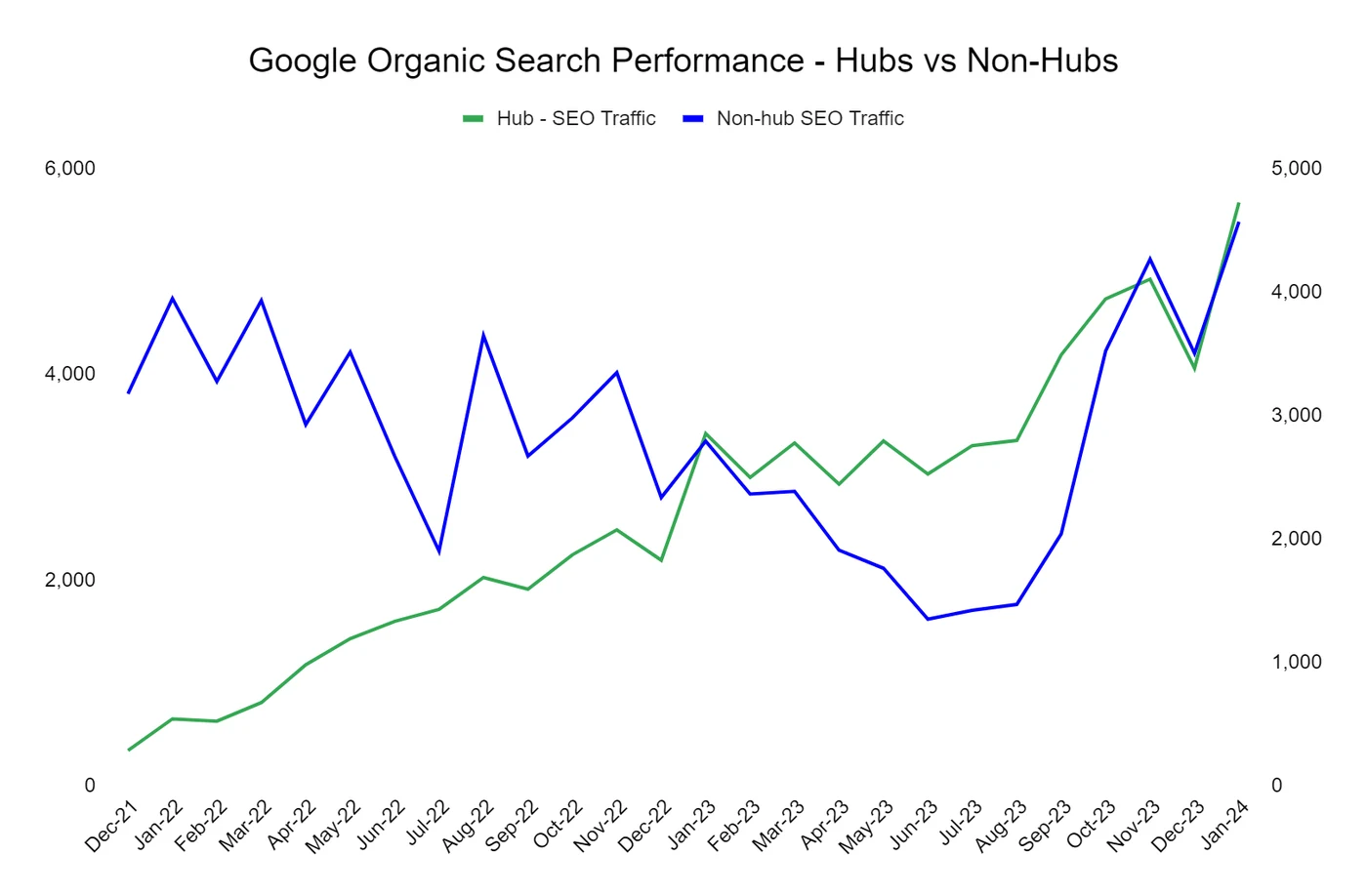
Content hub SEO traffic up 150% year on year
SEO traffic to the content hubs grew from 20,000 visits in 2022 to 50,000 in 2023.
Monthly hub traffic went from around 300 visits in December 2021 to around 5,600 in January 2024.
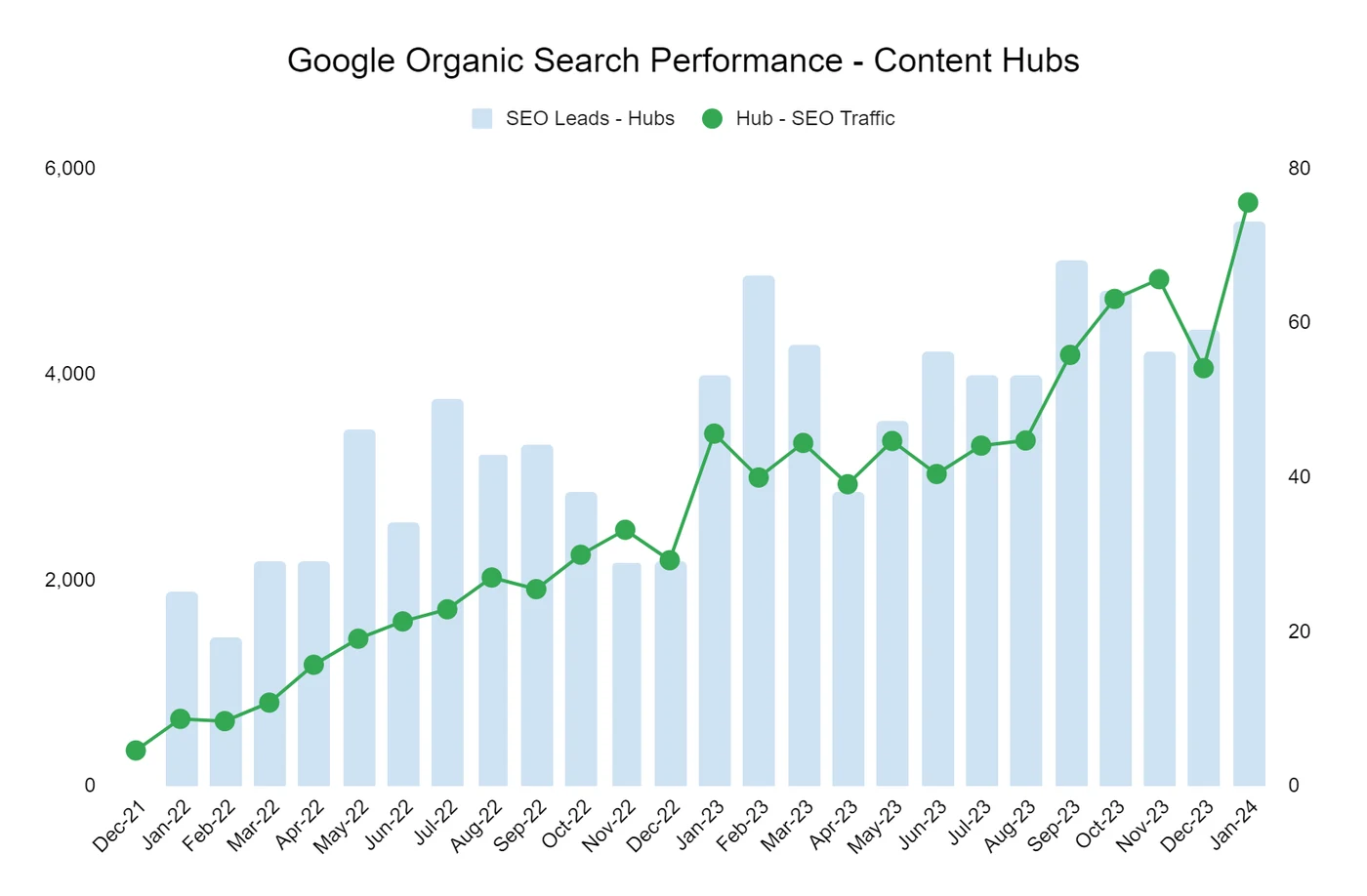
Content hub SEO leads up 69% year on year
SEO leads from the content hubs grew from 415 in 2022 to 700 in 2023.
That’s 285 extra finance leads from organic search in a single year.
Rankings followed
According to Ahrefs, Rangewell’s keywords ranking in the top 10 in the UK grew from around 250 in September 2022 to almost 800 by February 2024.
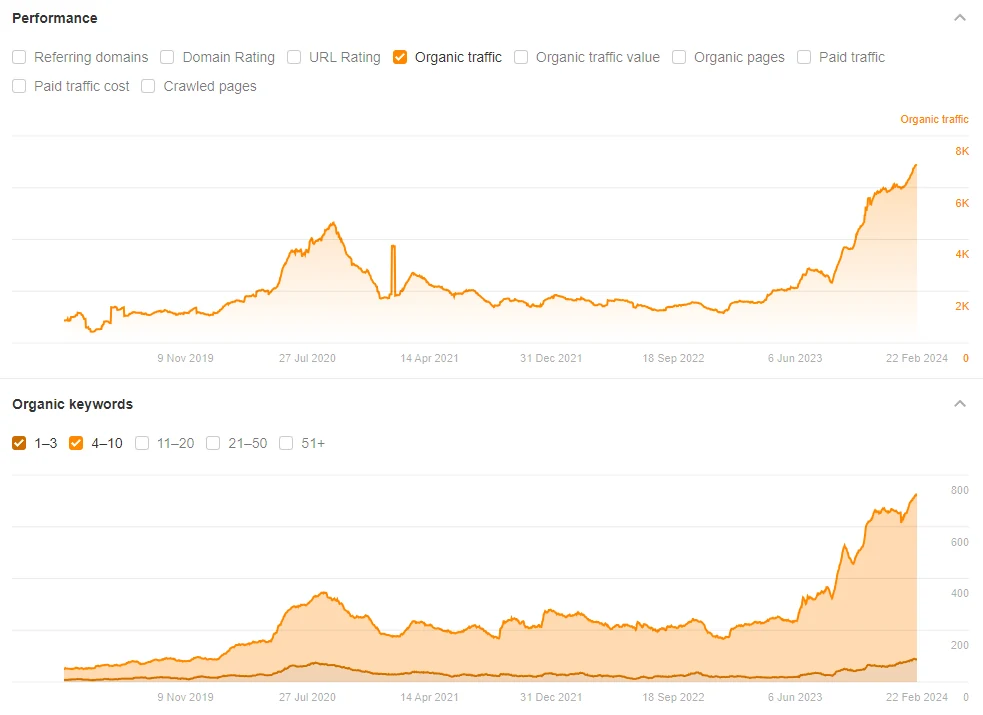
In Google Search Console, daily clicks more than doubled between October 2022 and February 2024.