SEO professionals need to be able to communicate complex ideas.
Yet many SEO professionals find it difficult to communicate their ideas to busy teams. This can impact their ability to get companies invested in SEO and projects executed.
One of the quickest wins to getting things done is to improve your communication skills:
"Getting things done sometimes comes down to making our case more effectively — either with more data or with a better argument." - Will Critchlow
Enter Barbara Minto's Pyramid Principle.
The Pyramid Principle is a technique business consultants use to communicate complex ideas to busy executives. Barbara Minto developed the framework while working at McKinsey.
It's the most popular communication and storytelling framework in consulting.
This essay will explain how to improve your communication skills using the Pyramid Principle.
The essay will cover the following topics:
- What is the Pyramid Principle?
- Why use the Pyramid Principle?
- How does the Pyramid Principle work?
- Examples of using the Pyramid Principle
- How to use the Pyramid Principle
- SEO Use Cases of the Pyramid Principle
🛕 What is The Pyramid Principle?
The Pyramid Principle is a technique for writing and communicating complex information to stakeholders. Barbara Minto created it while working at McKinsey in the 1970s and 1980s.
The pyramid is a visual representation of how your ideas and insights fit together.
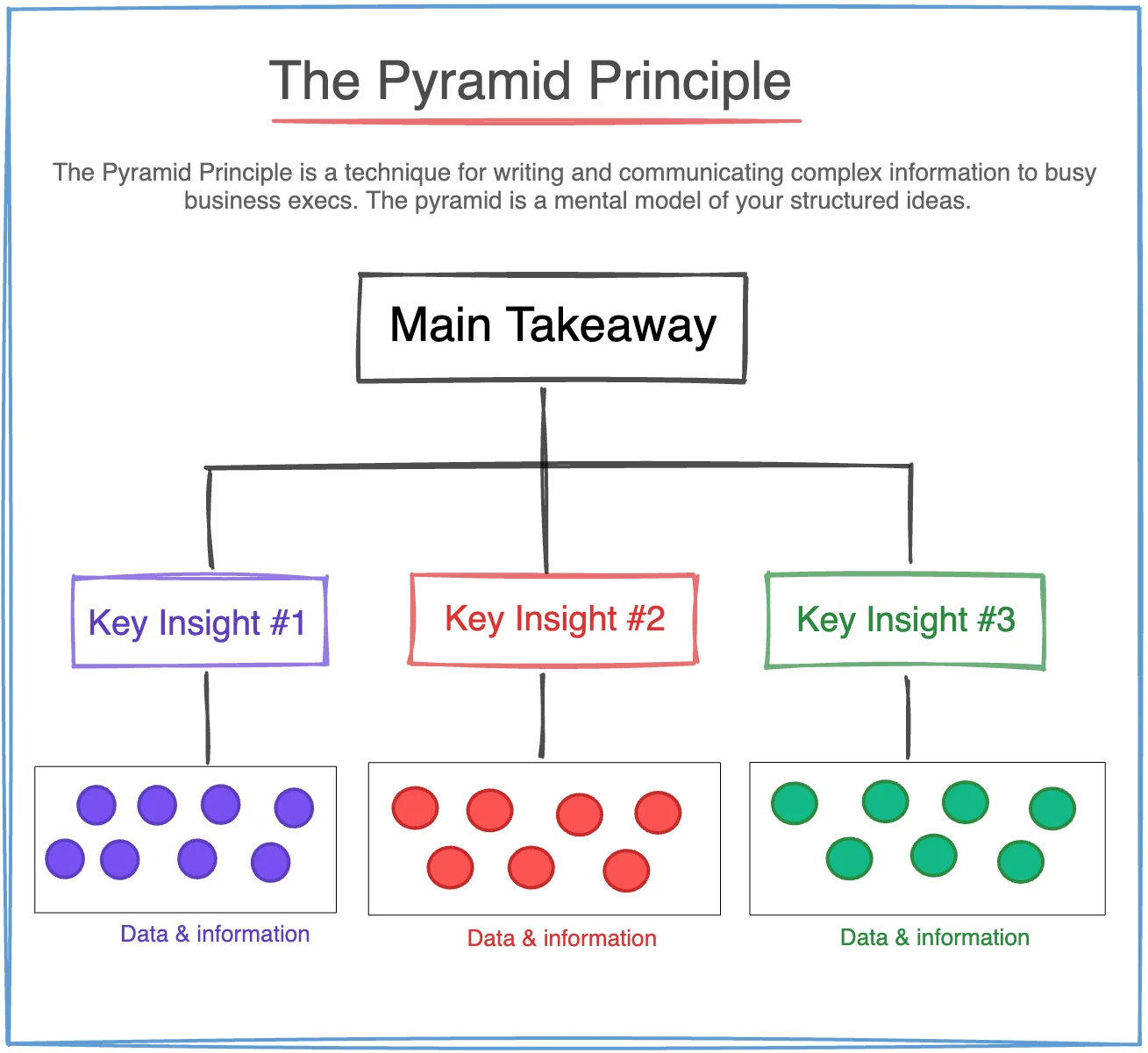
The Pyramid is broken down into three levels:
- Bottom level: This is your data, information and research.
- Middle level: The key insights and summaries based on your data/information.
- Top level: The main takeaway you communicate to stakeholders from lower levels.
For decades, the billion-dollar strategy and management consultancy market (BCG, McKinsey, and Deloitte) has used it to communicate complex ideas to busy business executives.
It's used to persuade leadership teams at companies to invest in business strategies.
🤷 Why use The Pyramid Principle?
The Pyramid Principle is effective and popular because it's based on how the human mind works.
The human brain has evolved to impose order on the world around it, and one of its core capabilities is to recognise patterns (source).
As we take in ideas one after another, our brain's pattern recognition feature assumes they belong together. And tries to turn them into a logical pattern we can understand (source).
Any human mind will group information based on similar characteristics or distance. For example, take a look at these six dots:
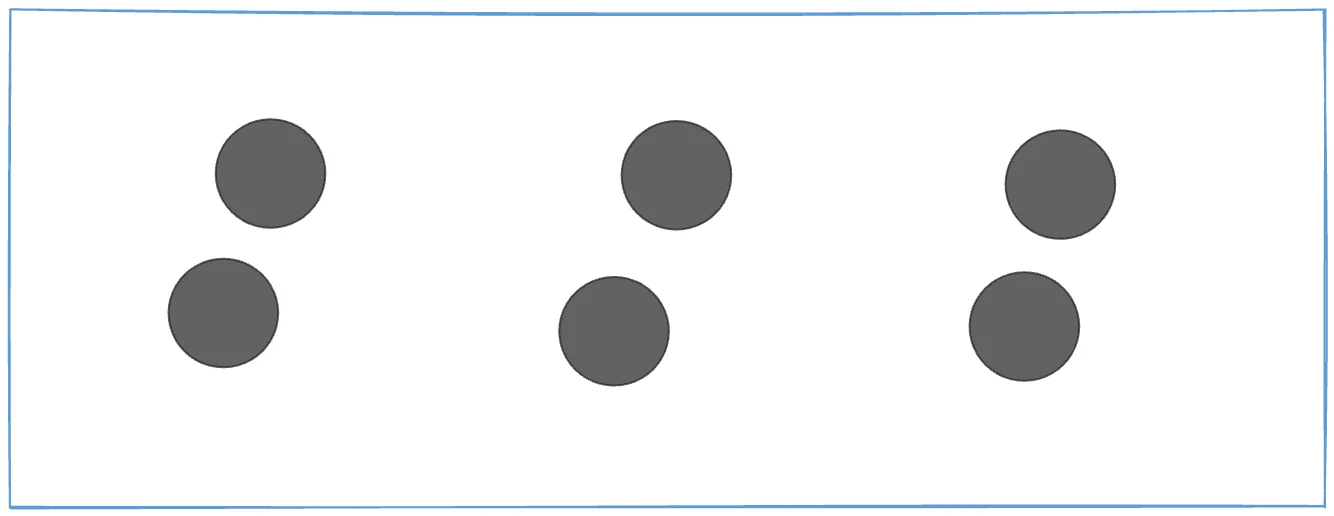
Your mind will automatically group these six dots into three groups of two because of their distance. This is your pattern recognition core functionality in action.
But where does the pyramid structure come from?
Well, according to Barbara Minto, pattern recognition in the human mind will always be a pyramid because of three factors:
- 📦 The Magical Number Seven - The average number of items and chunks of information that can be held in short-term memory.
- 🔂 The Logic of Relationships - The relationship between categories and items must be clearly stated.
- ⏬ Ordering from the top-down - The clearest communication presents information from the top down.
📦 The Magical Number Seven
Anyone's ability to process information in their short-term memory is limited.
How much information can you process?
According to George A. Miller, an American psychologist at Harvard in 1956, the number of objects an average person can hold in short-term memory is 7 (plus or minus 2). Some people can remember 3 or 5 items, while others can remember as many as 9.
This short-term memory limit is called the magical number seven, plus or minus 2.
What is interesting about George A. Miller's research is that if the mind processes more items than it can handle, it begins to group information into logical categories (source).
Let's look at an example.
You have a shopping list with 10 items. Your mind will automatically group items on the list into logical categories based on location in the supermarket:
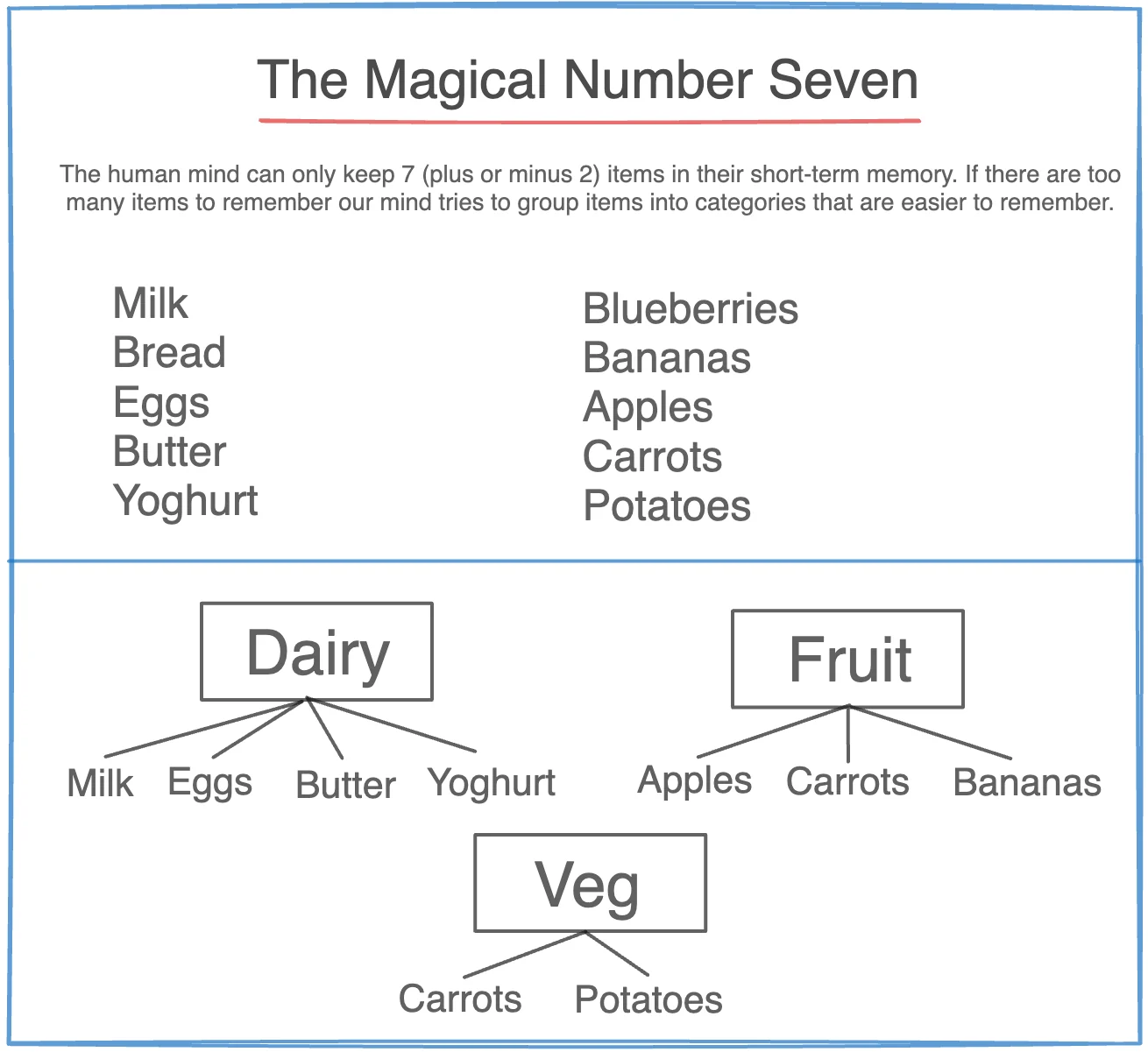
These categories and the items beneath them form the pyramid structure. They form a pyramid because the items in your memory are grouped under each category. And you remember them in order (one after the other).
The shopping list is easier to remember because of the pyramid structure.
🔂 The Logic of Relationships
It's not just about grouping items together to make remembering easier.
The relationship between categories and items must be clear. The mind will expect the items within the group to be characterised based on the category name.
For example, take the shopping list. The categories should be self-explanatory. They are grouped based on the location within the store, but it's always important to state it clearly. The mind will be able to spot out-of-place items based on the category name:
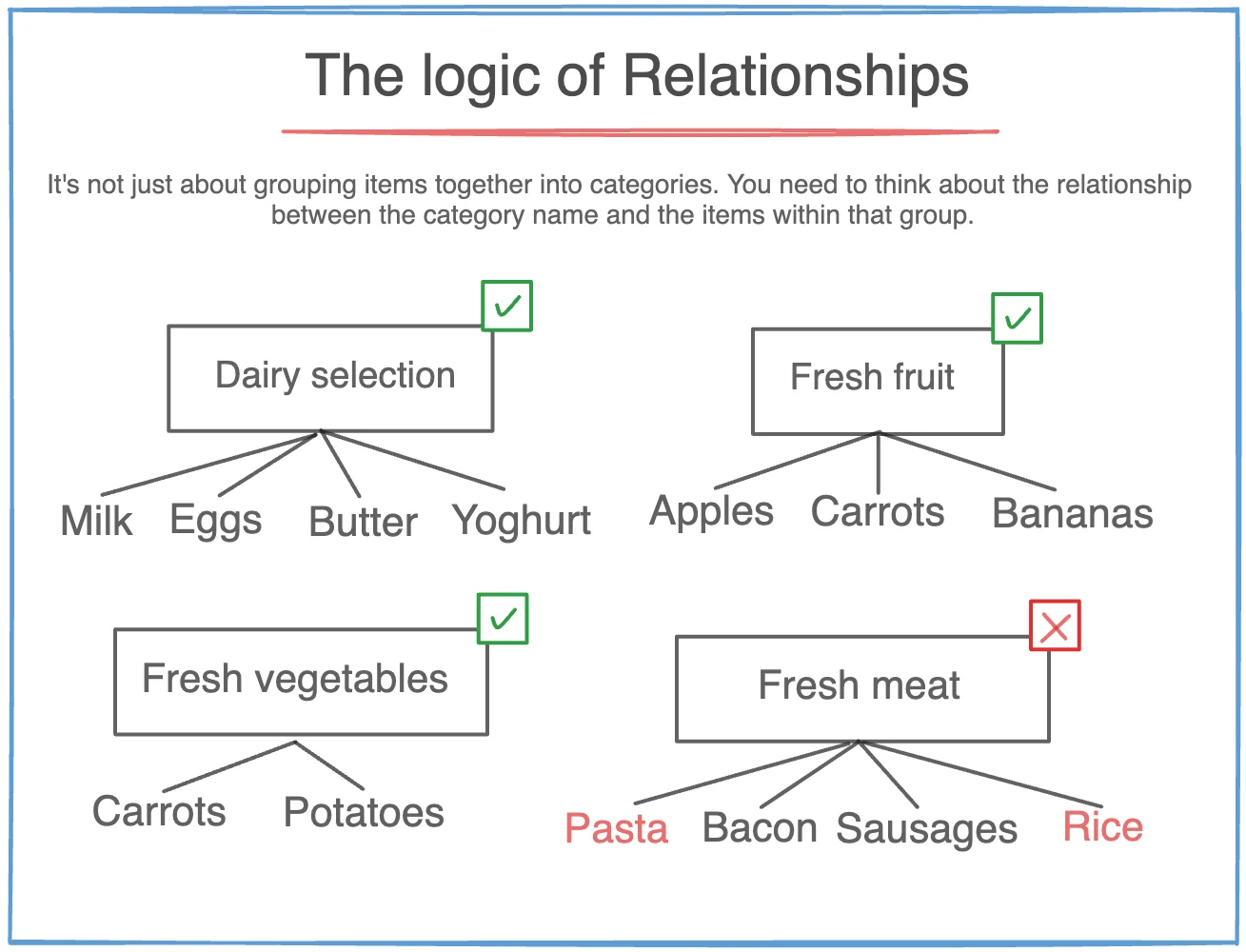
It's not just the category-item relationship that needs to be clear. The relationship between the categories also needs to be clear.
If the sequence of categories isn't clear, it can be hard for others to digest the information.
For example, take your shopping list.
The order of the categories on the list matters. You'd want to order them based on the shop's layout. Ordering the categories based on the location near other categories would make sense. As this would make it quicker.
If the order of the categories were random, then the person reading the list would be less efficient in picking up items:
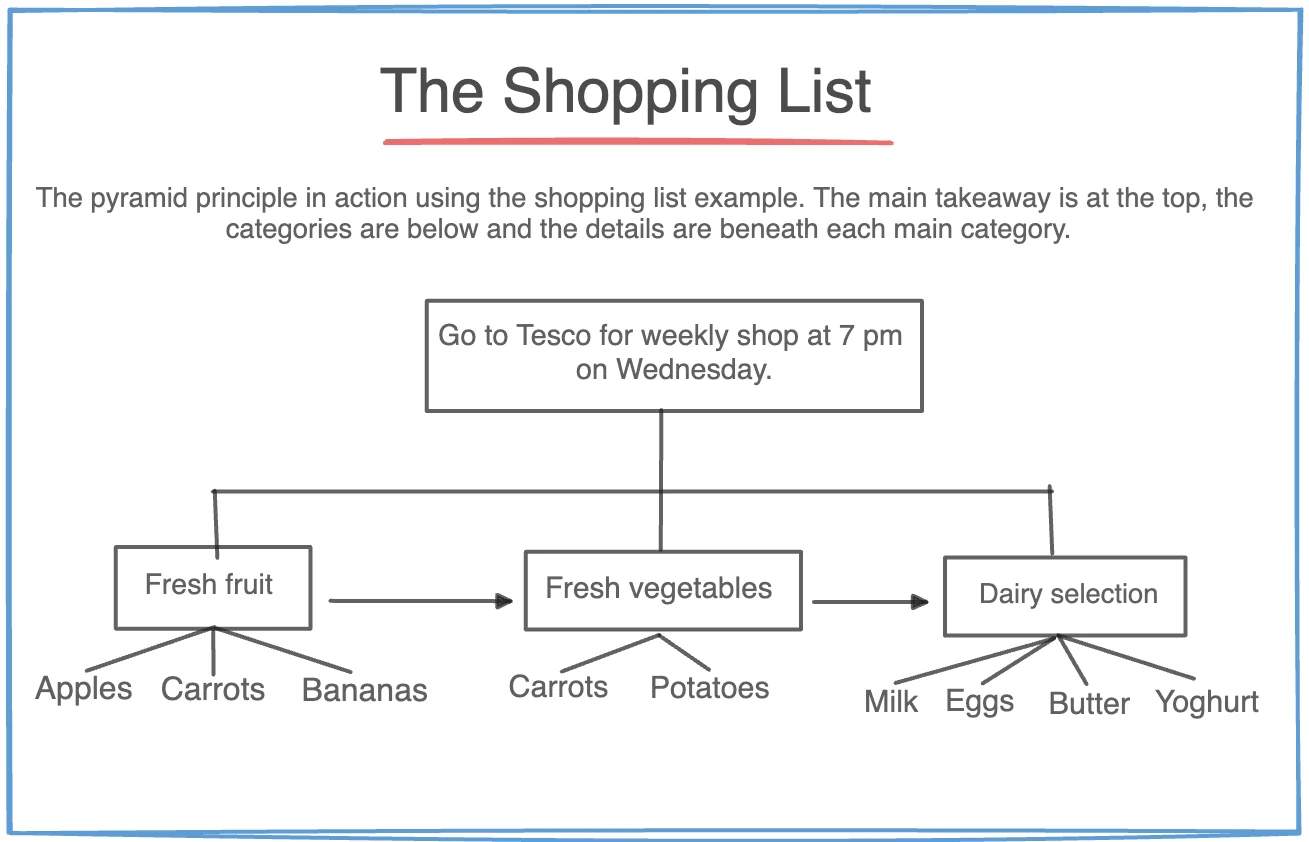
Barbara Minto states that all mental processes (thinking, remembering, problem-solving) use this grouping and summarising process to identify patterns.
These groups and summaries form the first two levels of the pyramid in the human mind.
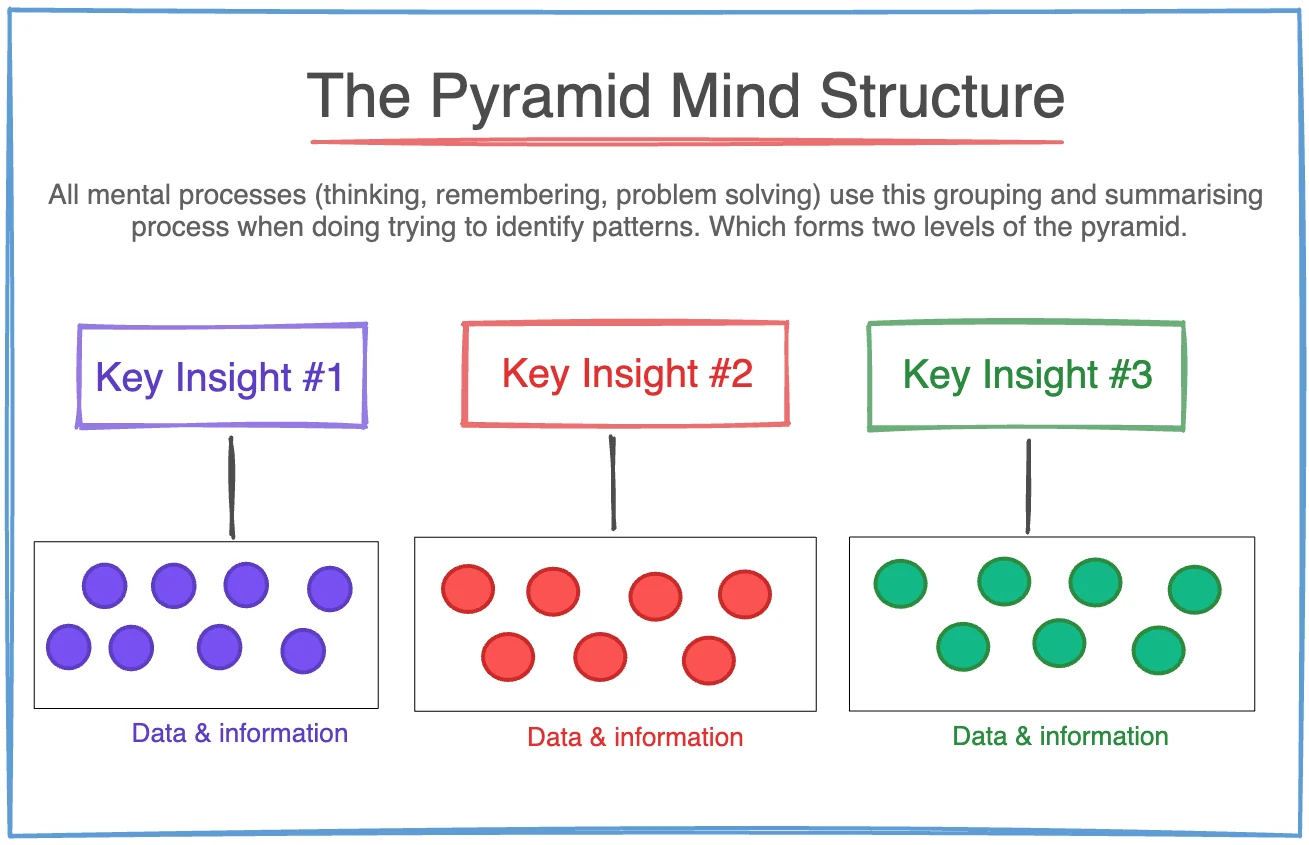
⏬ Ordering from the top-down
The clearest communication presents information from the top down.
The human mind can only take in ideas one at a time. No matter how smart the audience, they will always have limited mental energy to process your ideas. So, it's important to make sure they spend the least mental effort comprehending a set of ideas.
So, controlling the sequence in which ideas are given is critical to get the point across. The clearest communication is always giving the summarised idea before giving the details.
You start with the main point, provide key insights and end with the details:
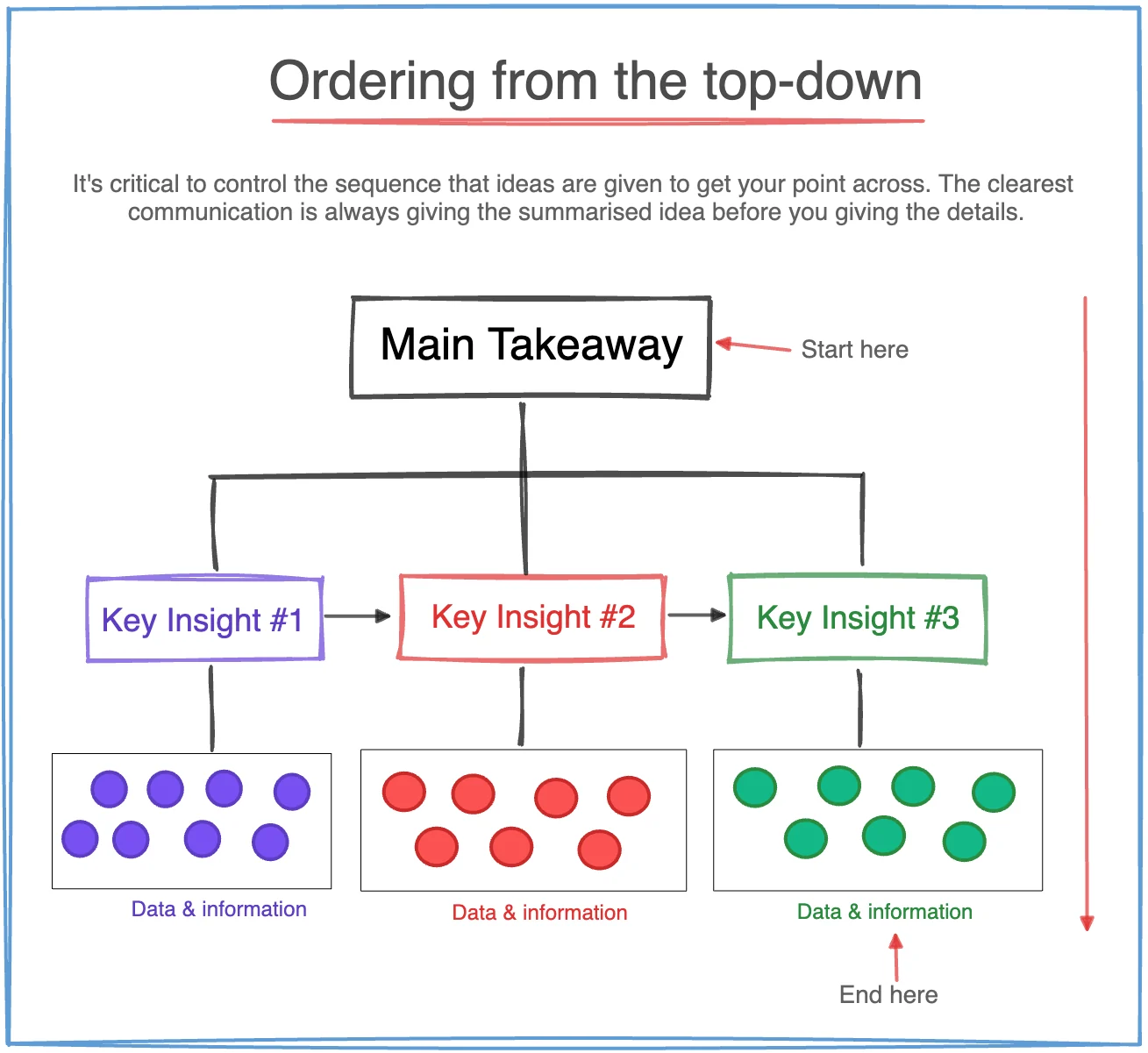
Let's use the shopping list as an example.
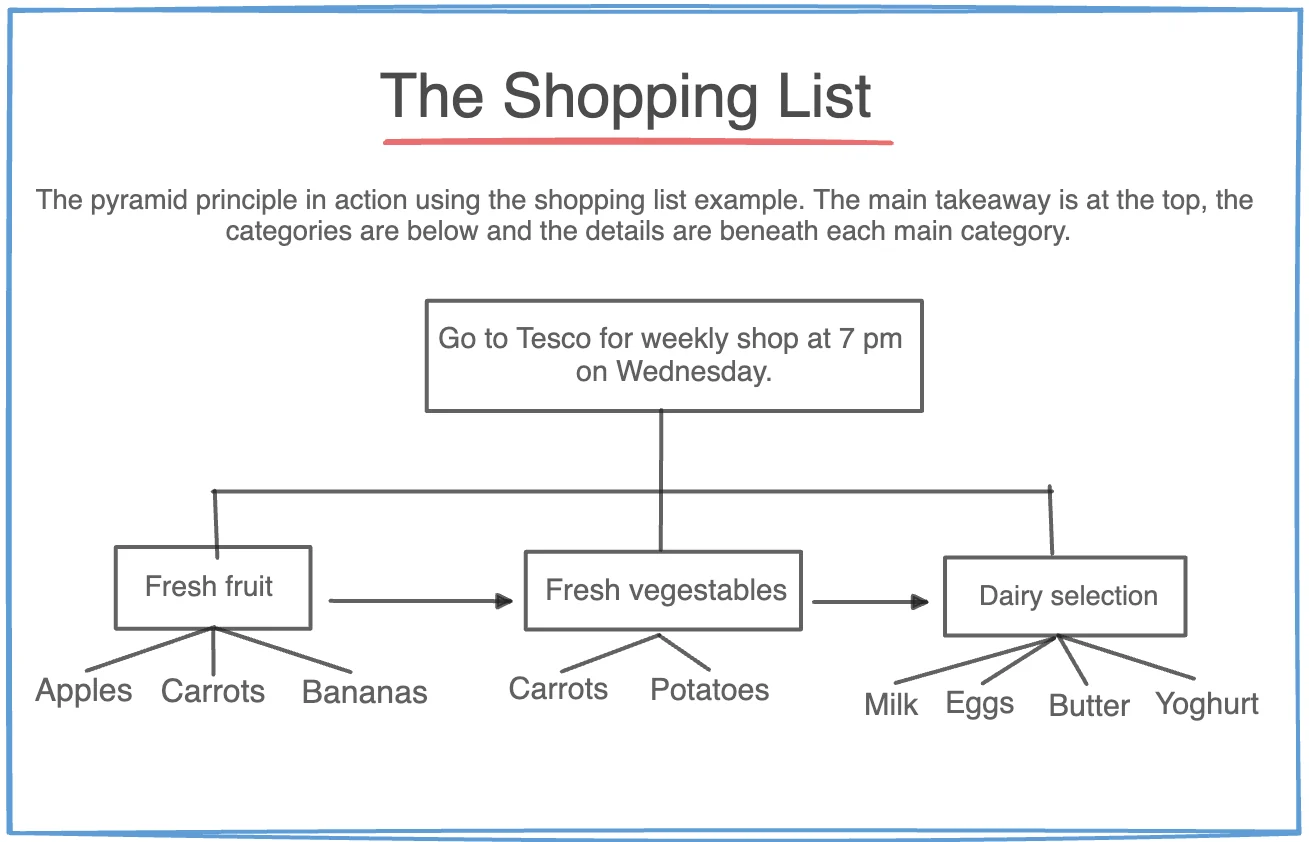
You would start by communicating the main point: shopping needs to be done by a time and date. Then, state the categories of food needed (ordered by location). And finish by explaining the items needed from each category:
⚙️ How does The Pyramid Principle work?
The Pyramid Principle is split into two parts:
- Top-down thinking - Identifying a problem and a hypothesis before identifying the components that will help solve the problem.
- Bottom-up thinking - Identifying the components of any system with data and determining what you can do with them.
🔽 Top-down thinking
Every document or presentation must solve a problem by answering a key question.
For example:
- How can we grow the SEO visibility of our website?
- Why is our website seeing YoY declines in SEO traffic?
- What are our SEO competitors doing to rank for X keyword?
The writer or presenter must use top-down thinking to identify the problem and key question.
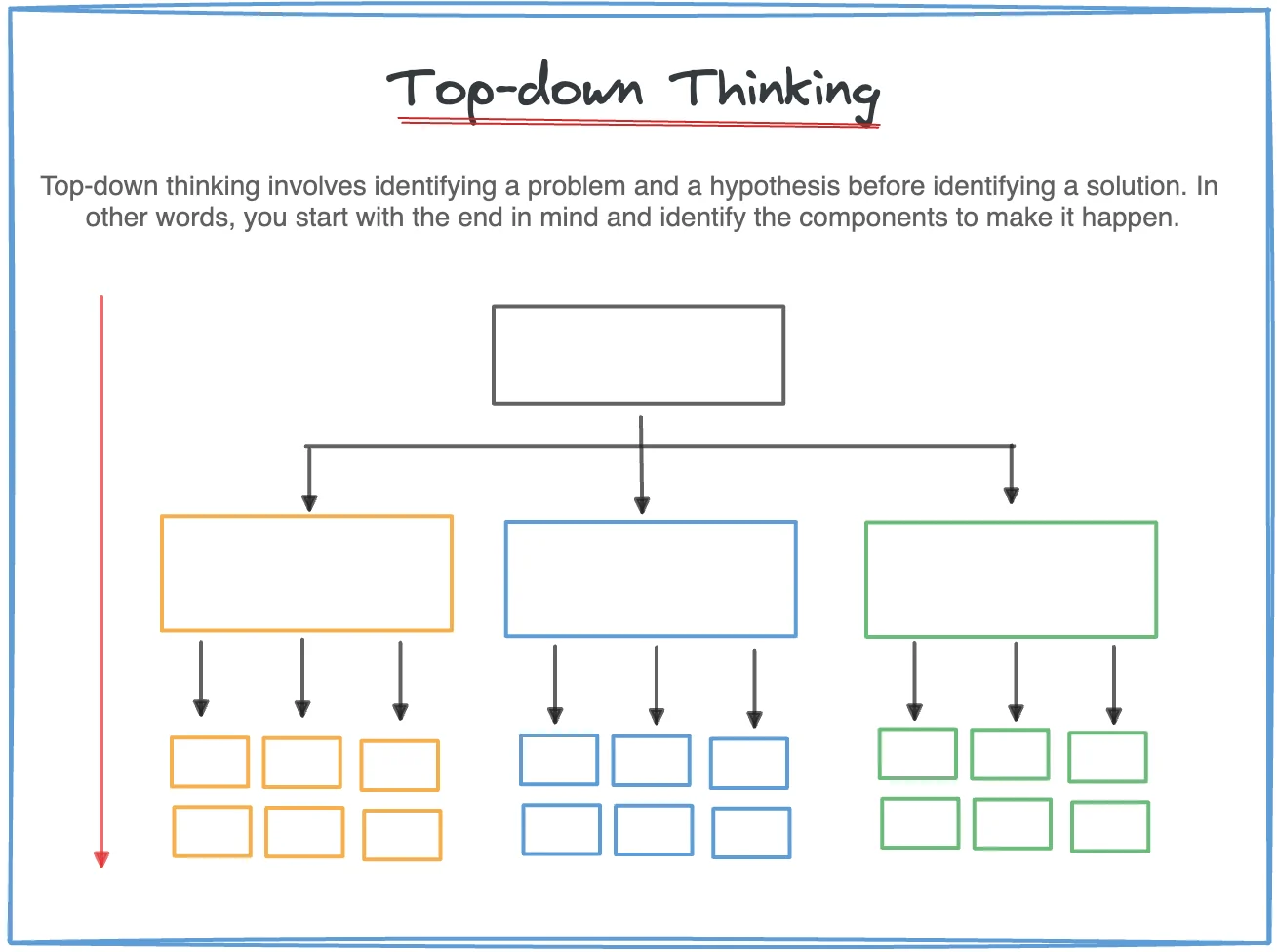
Top-down thinking involves identifying a problem and a hypothesis before identifying a solution. In other words, you start with the end in mind and identify the components to make it happen.
How do you identify the question and problem?
By using the SCQA framework.
SCQA stands for Situation, Complication, Question and Answer. Barbara Minto created it to help identify the key question a document or presentation needs to answer.
Each statement in the framework helps define the context of the problem and the key question that needs to be answered. The framework also makes sure that the answer, supporting arguments, and data fit within the rules of constructing a pyramid.
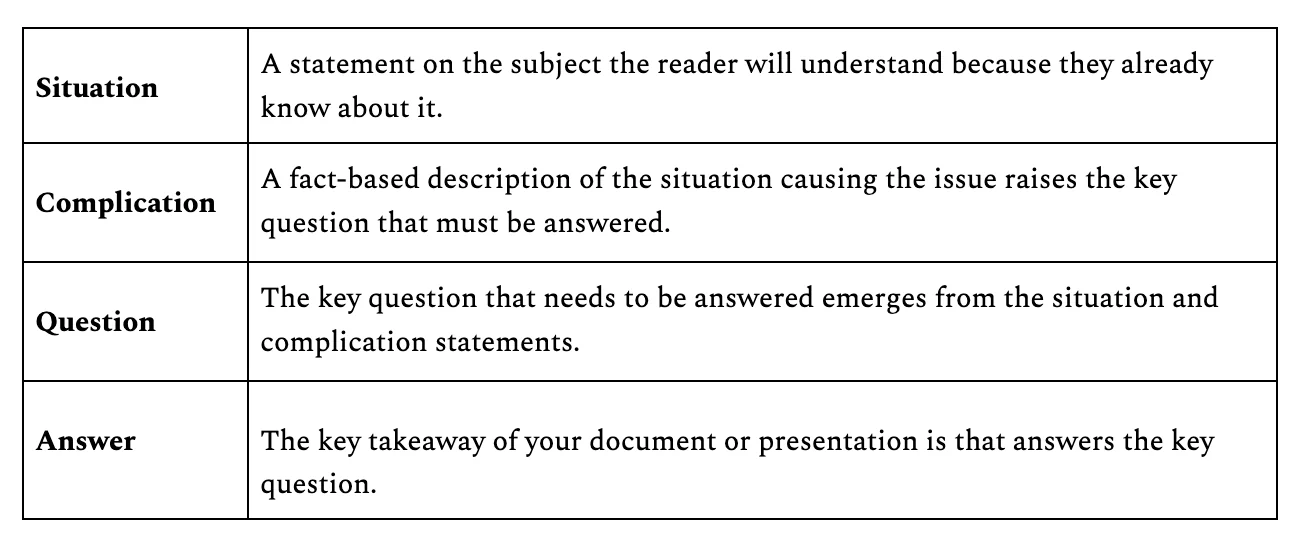
The situation and complication statements help a consultant understand the business problem. And allow them to clarify the question before doing any research or analysis.
This means the SCQA framework is not optional when using the Pyramid Principle.
You must use the SCQA framework to make sure you understand the problem and main question in your mind. If it isn't clear, you'll waste your time doing research and analysis that completely misses the mark.
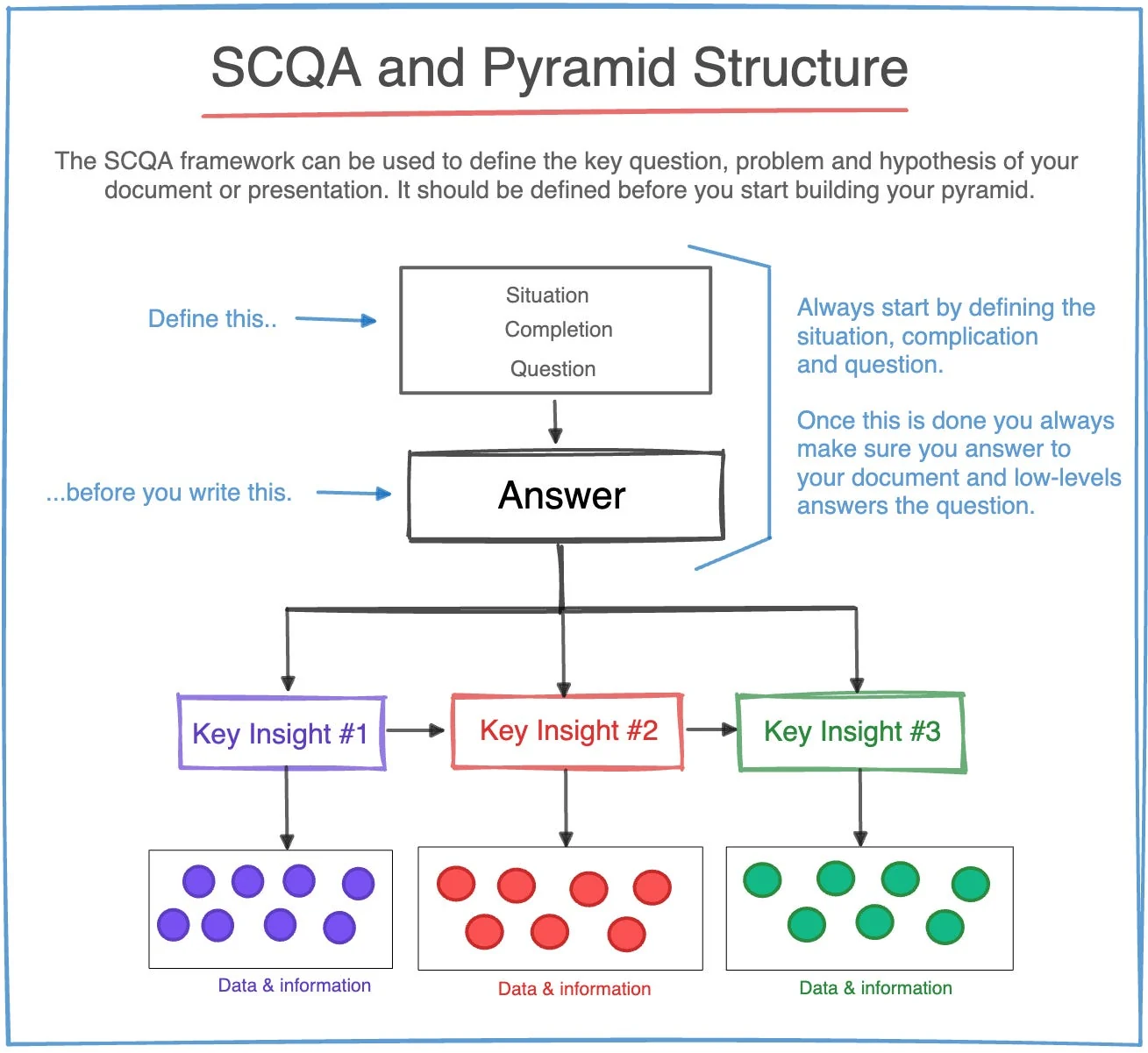
Once you have defined the problem and question, you can start to identify solutions. This is where bottom-up thinking can help identify a potential answer to the key question.
🔼 Bottom-up thinking
Every document or presentation must answer the key question.
For example:
- How can we grow the SEO visibility of our B2B website?
- To grow organic traffic for our B2B website, we must build content hubs around key product topics.
- Why is our website seeing YoY declines in SEO traffic?
- Several Google core algorithm updates have affected our website over the last 12 months, and we need to invest in UX, content, and technical initiatives to reverse the decline.
- What are our SEO competitors doing to rank for revenue-driving keywords?
- Our competitors are investing in content that's driving links from authoritative websites, and we need to invest in similar activities to compete for revenue-driving keywords.
The writer or presenter must use bottom-up thinking to identify the answer to the question based on the available data and information.
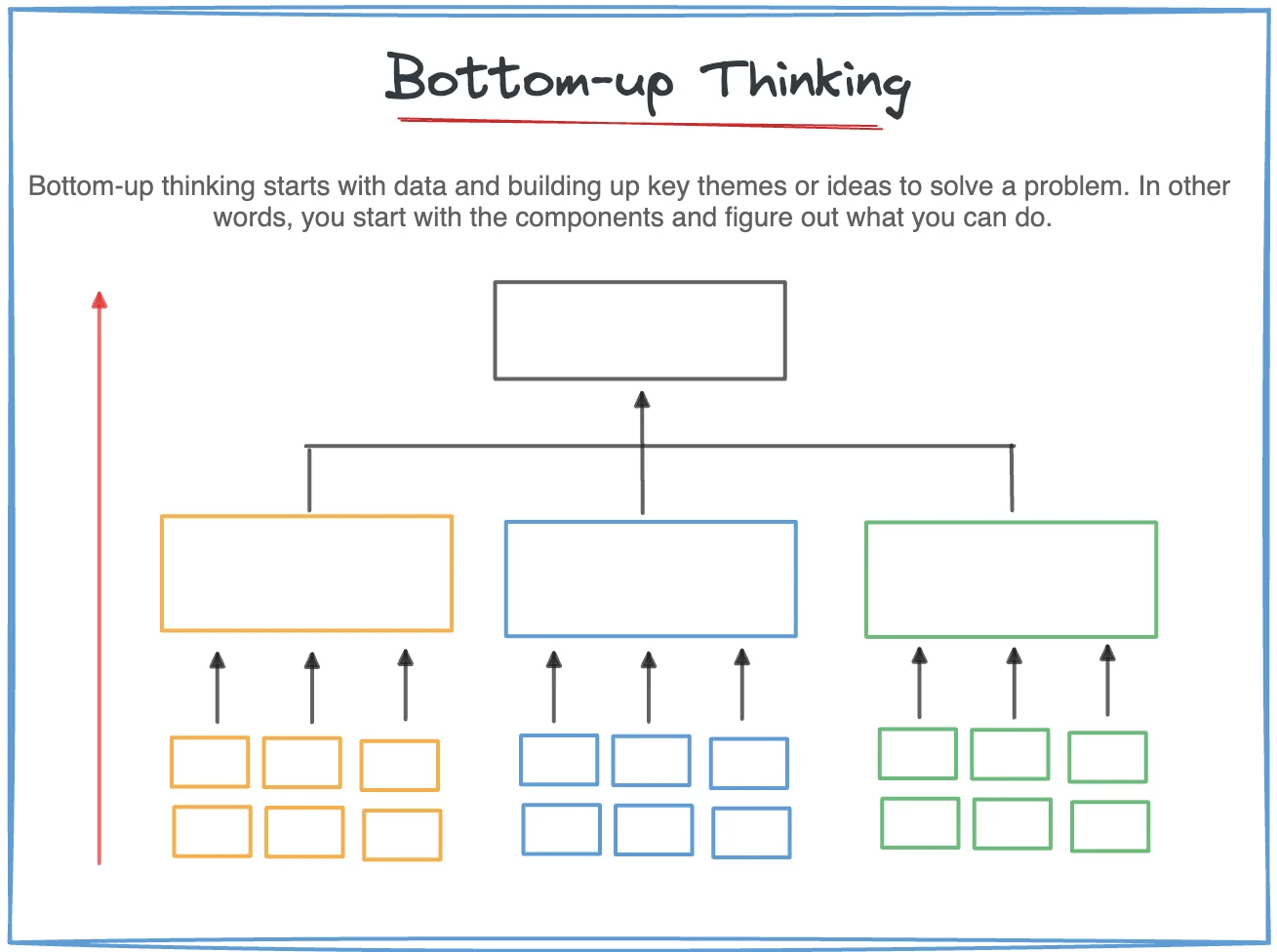
Bottom-up thinking starts with data and building up key themes or ideas to solve a problem. In other words, you start with the components and figure out what you can do.
But how do you find the answer to the question and provide supporting arguments?
By doing research/analysis and using the MECE principle.
The acronym MECE stands for Mutually Exclusive, Collectively Exhaustive. It's a grouping principle developed by Barbara Minto to help separate data/info into key insights. And a method for mapping complex ideas into the best sequence that anyone can understand.
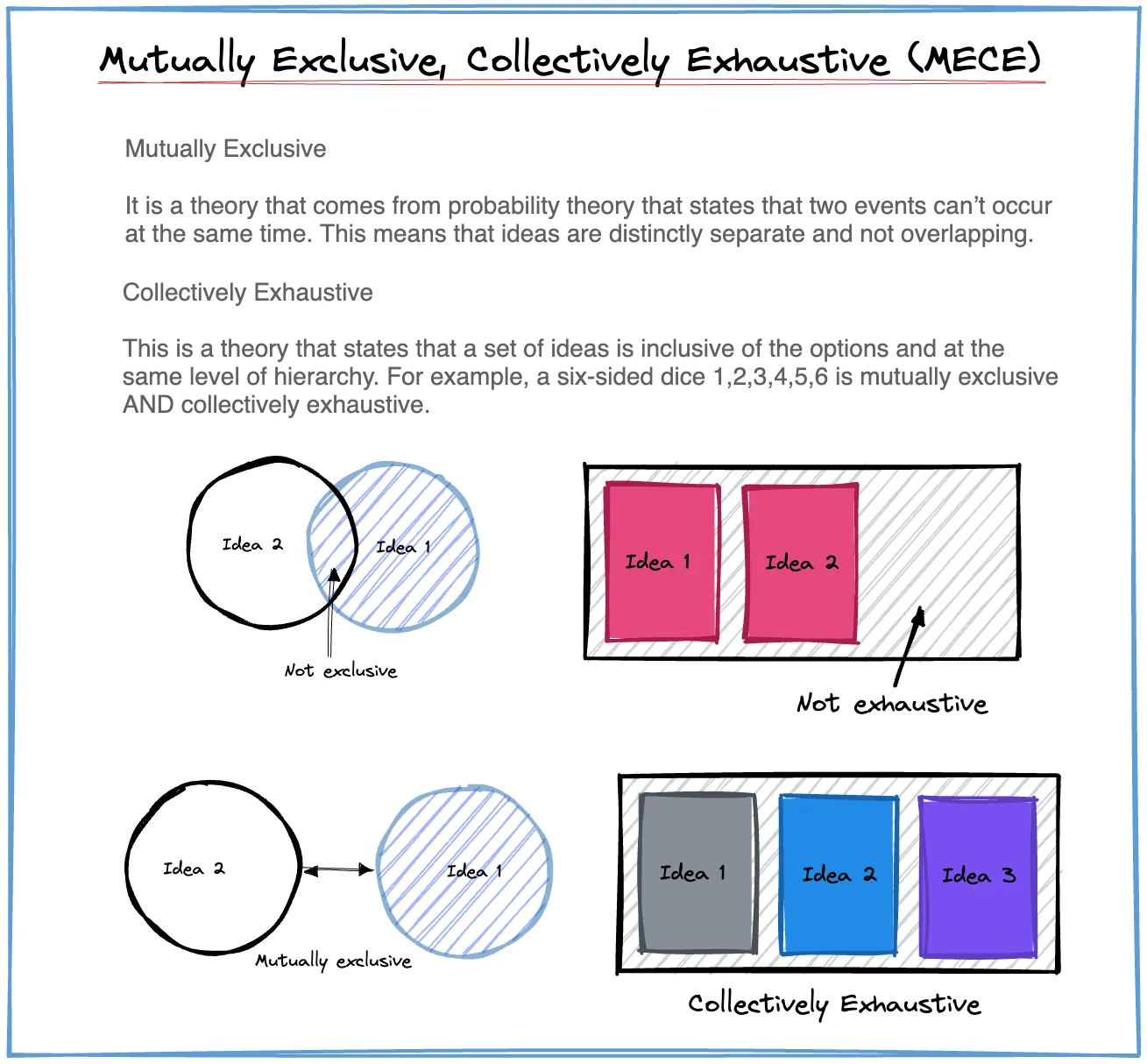
This grouping and summarising principle helps consultants construct an answer and supporting arguments using data.
It's important to understand that the MECE principle is not a law. It's a means to an end.
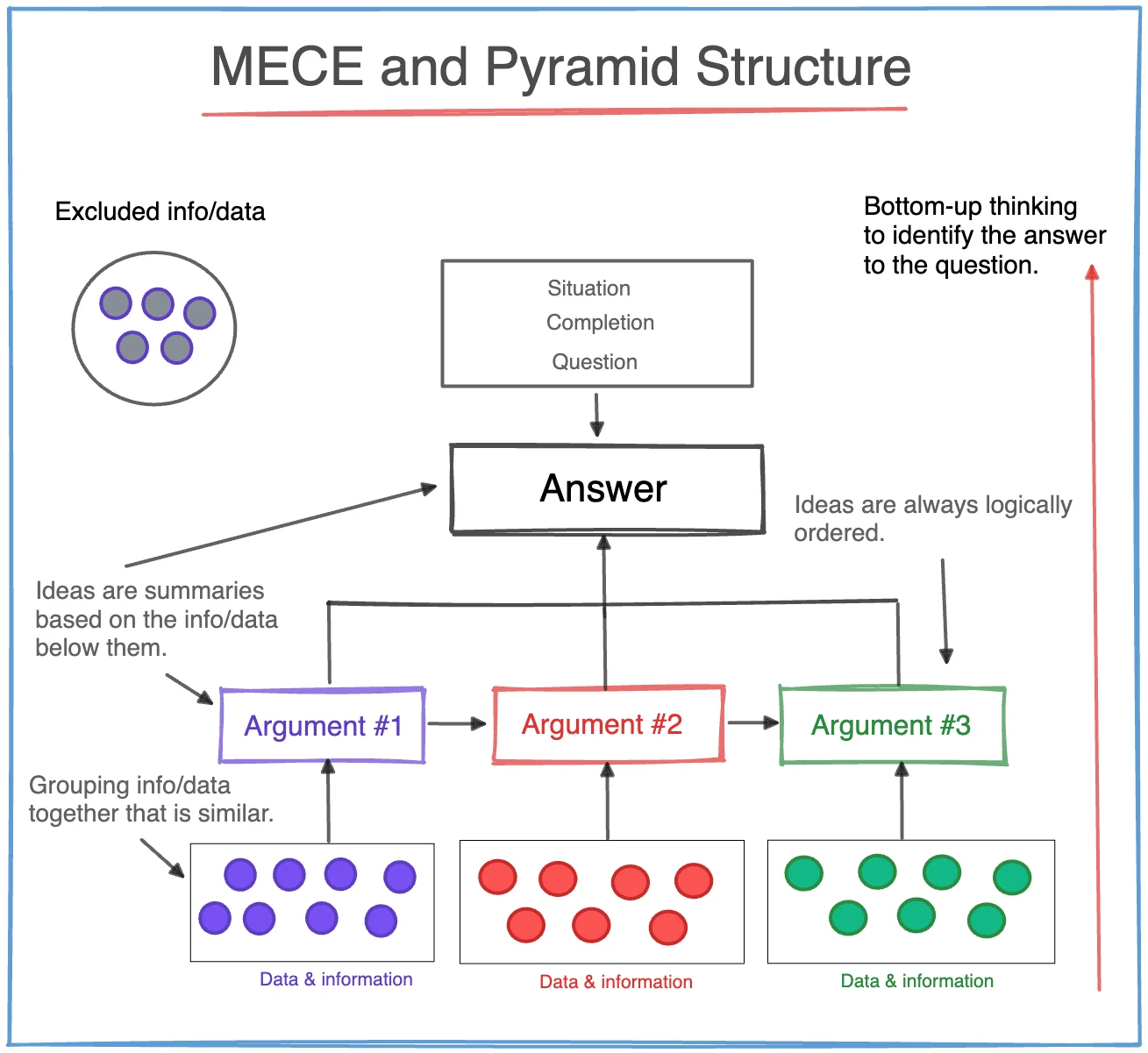
But, Barbara Minto argues in her book that the pyramid needs to follow these three grouping and summarising rules to be effective:
- Ideas at any level must be summaries of ideas grouped below them.
- Ideas in each grouping must always be the same kind of idea.
- Ideas must always be logically ordered.
When writing or presenting to an audience, you must ensure that research and data are always grouped and summarised into key insights. Then, you summarise these insights into one clear answer to the document's key question.
Then, you present from the top down in your document or presentation.
If you find info/data that doesn't help answer the question while grouping and summarising, you exclude it from your document or presentation.
To keep your communication clear.
🍫 Examples of the Pyramid Principle in Action
Management and strategy consultants use the Pyramid Principle in many different ways:
- Persuasive Presentations - Create slide decks that help make business decisions.
- Persuasive Slides - Create slides within presentations that are easy to digest.
- Documents - Write emails, memos and briefs that persuade business teams to act.
Below are a few examples of the technique in action.
📽️ Persuasive Presentations
The Pyramid Principle helps consultants build persuasive presentations.
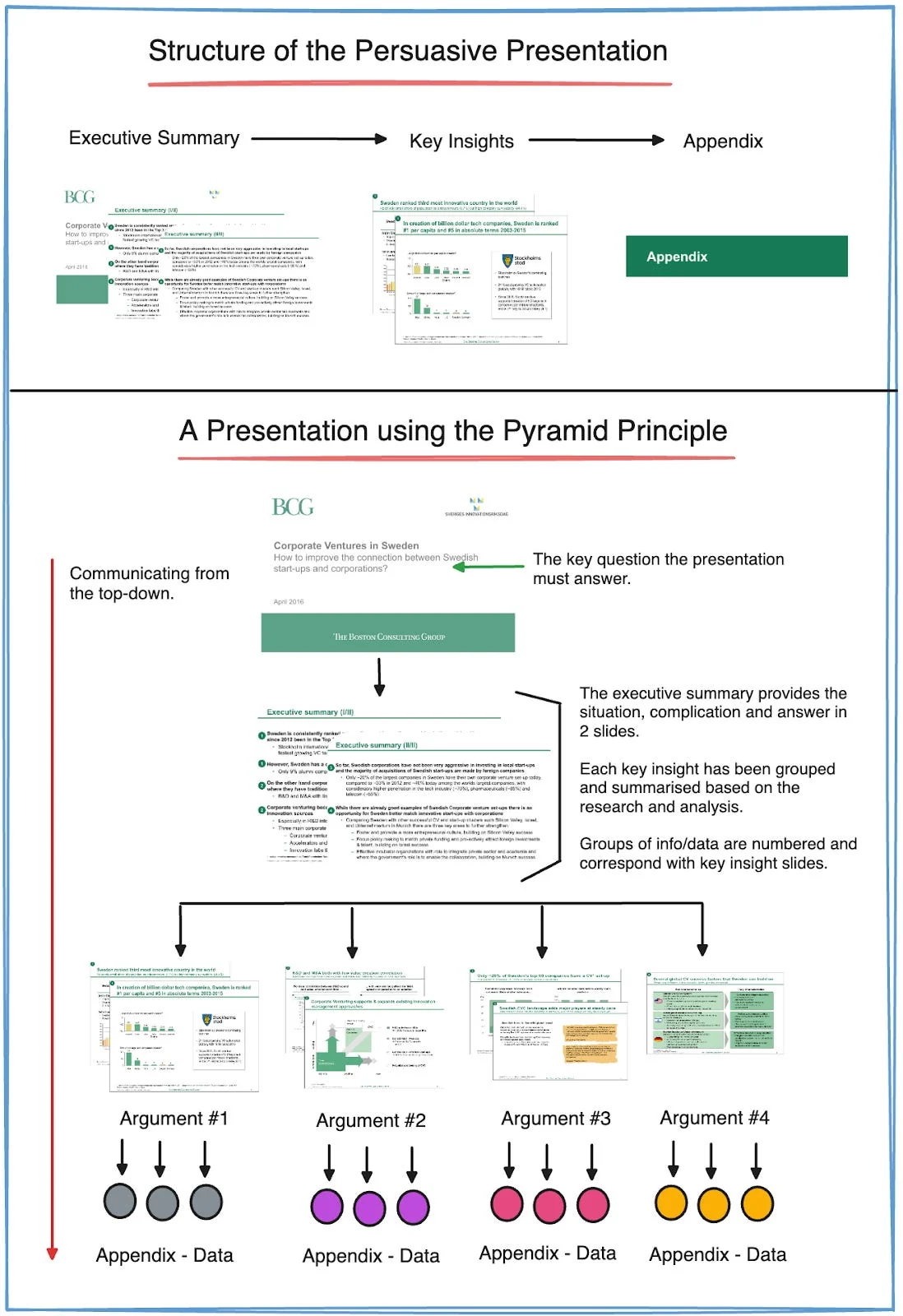
An example is the "Corporate Ventures in Sweden" from the Boston Consulting Group (BCG).
The presentation includes the following:
- Title: This states the key question the presentation is answering.
- Executive Summary: This states the situation, complication and answer.
- Key Insight: The summarised and grouped data/info to support the answer.
- Appendix: The data and information that the key insights and answer is based on.
The presentation communicates from the top down to answer the question, "How can we improve the connection between Swedish startups and corporations?".
It uses the grouping and summarising principle to answer the question. And includes the data in the appendix. Which makes the presentation easier for the audience to digest.
🍕 Persuasive Slides
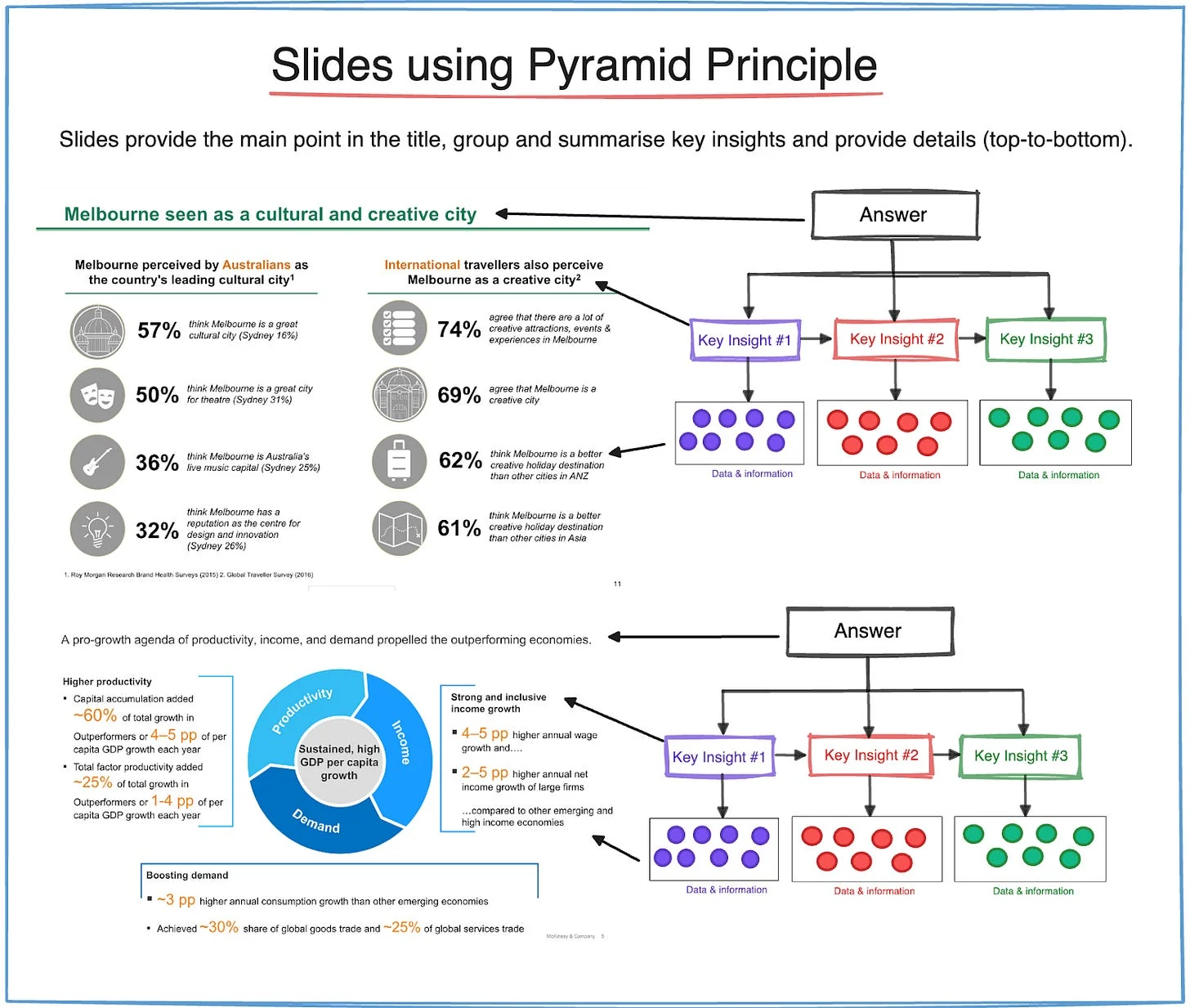
Consultants use The Pyramid Principle on a micro-level to help build persuasive slides.
If we look at BCG and McKinsey slides, we can see that they use the pyramid structure to construct persuasive slides.
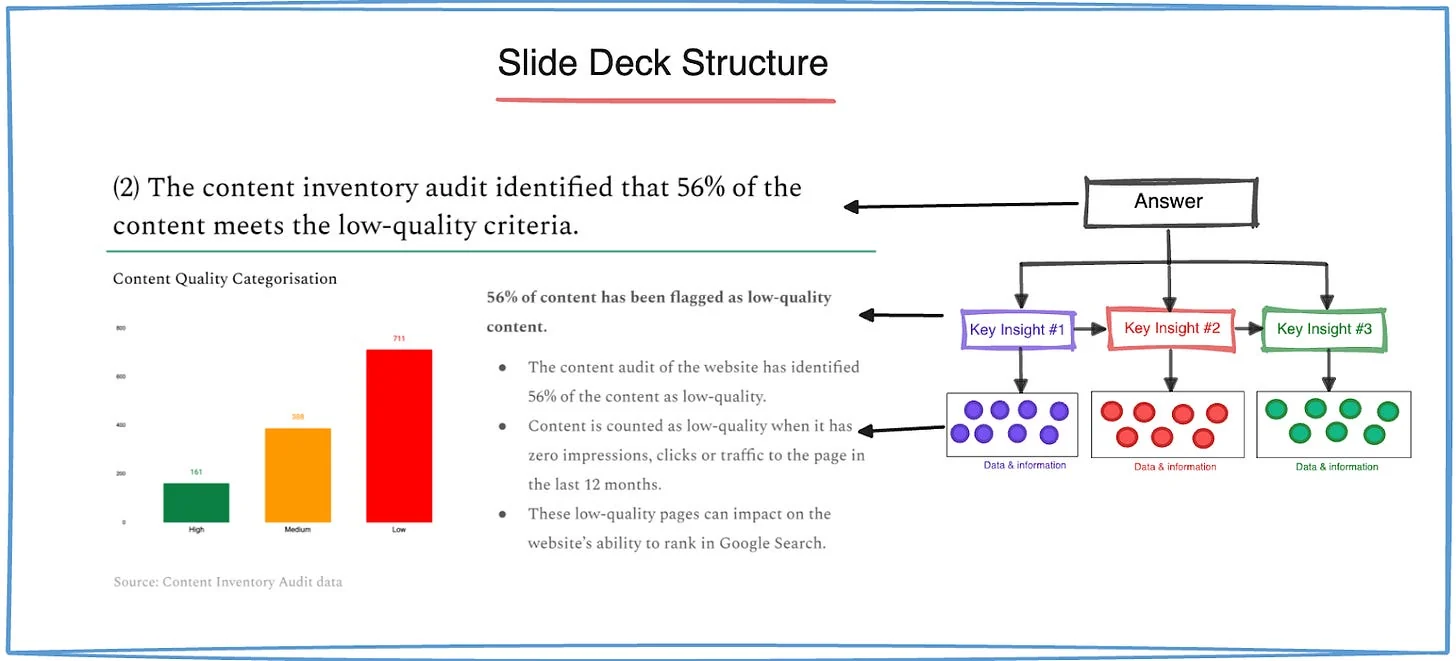
The slides provide the main point in the slide title, group and summarise the key points, and then provide supporting details. This is the same structure used to build an entire presentation.
The slides get their point across by using the top-down technique. And help the audience use as little energy as possible to understand the point the slide is trying to make.
📝 Documents (Memo, email, briefs)
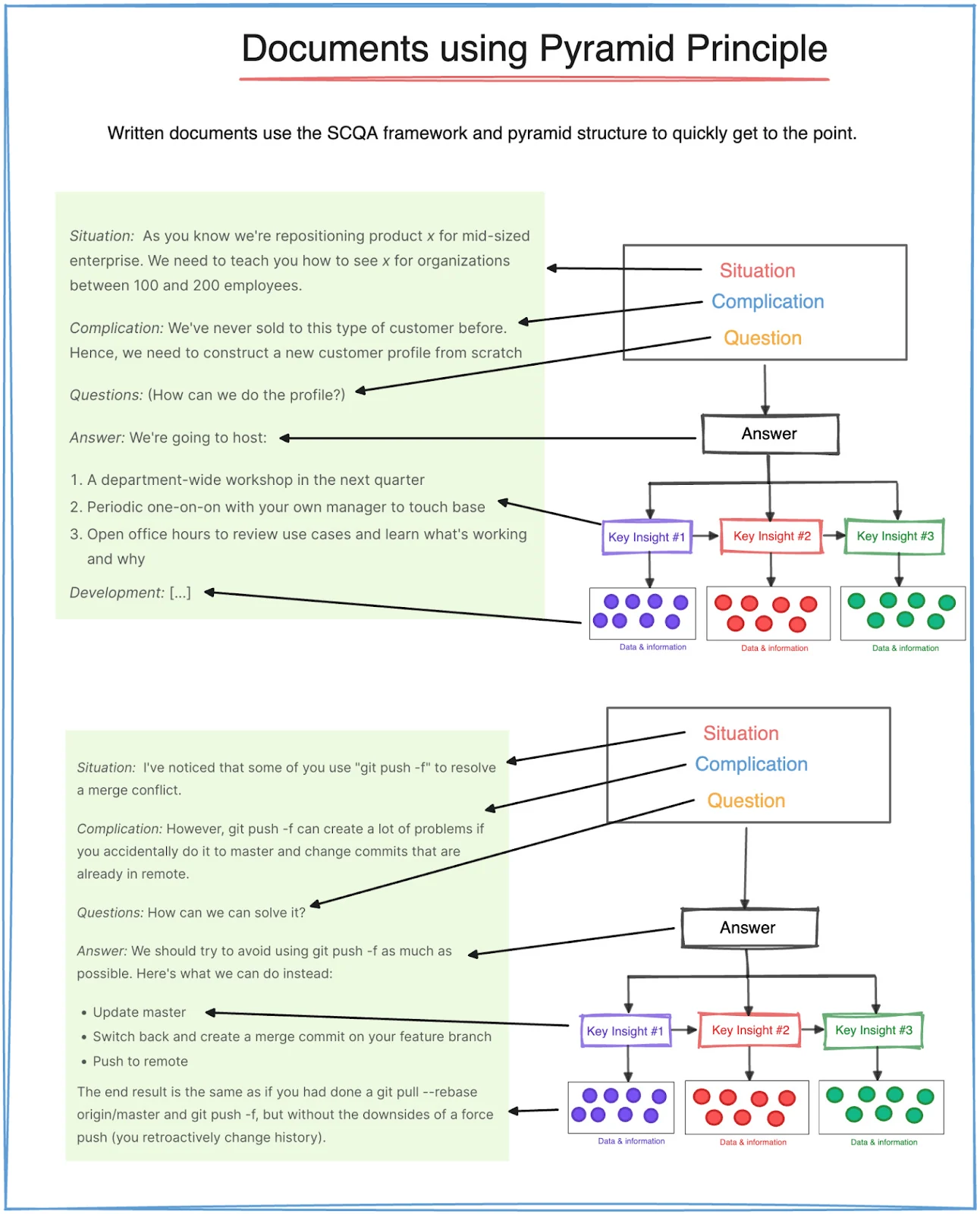
Consultants use The Pyramid Principle to communicate their points in written documents. It allows them to control the sequence of ideas and get their point across faster.
In the written documents from CFI and Pulse Async, you can see the Pyramid Principle in action.
The written documents use the SCQA framework to set the context and provide the answer. Then, they use the grouping and summarising principles to support the answer with clear arguments. Finishing off the document with details if needed.
Like the slides, the documents get to the point using the top-down approach. And can be understood by the reader using as little brain power as possible.
✍️ How to use the Pyramid Principle?
A consultant using the Pyramid Principle will present ideas in the following three steps:
- 🧪 Define the problem and key question
- 🧱 Write and structure your insights
- 🗣️ Communicate the main takeaway and insights
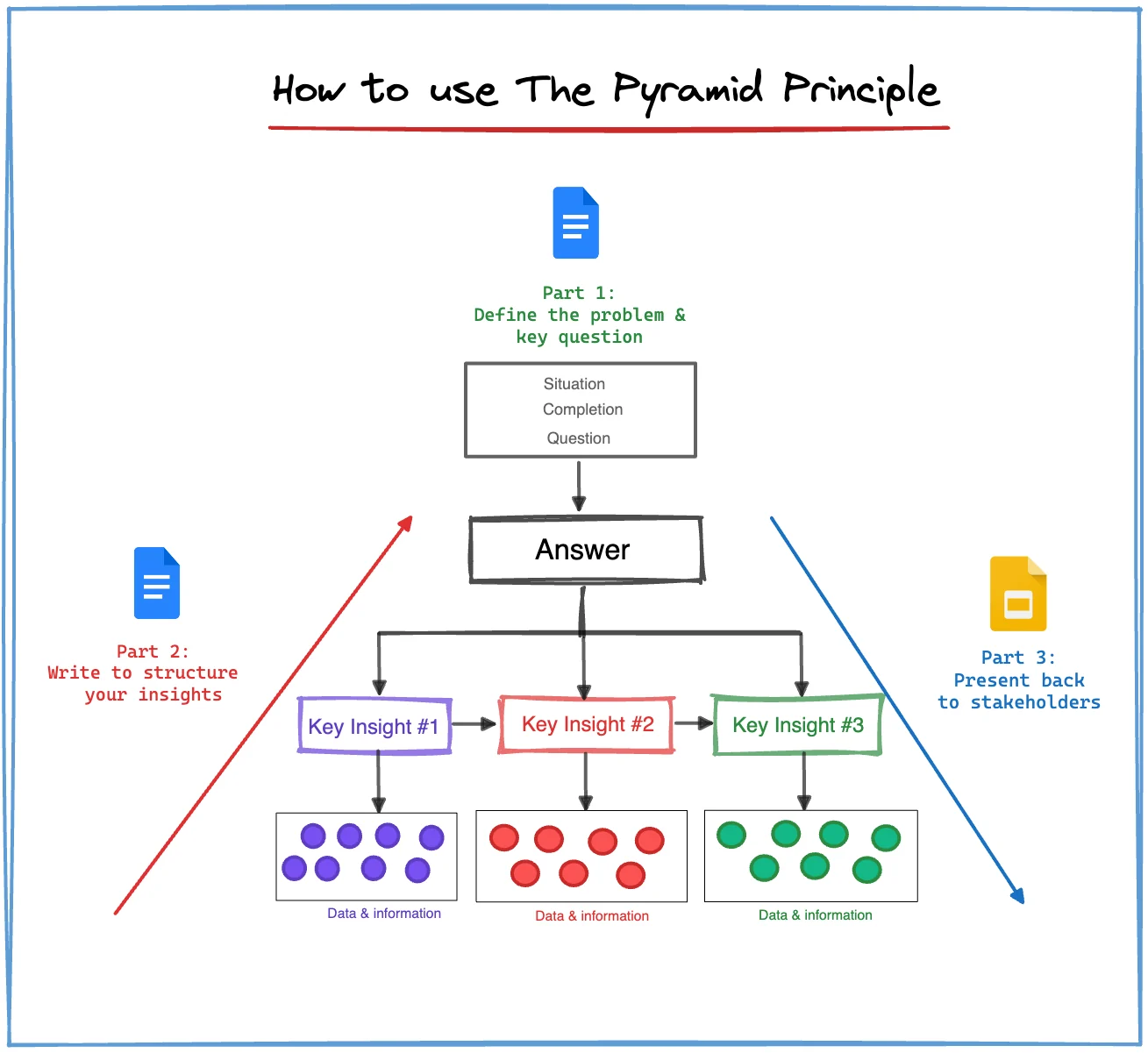
#1 Define the problem and key question
Let's say the consultant needed to put together an SEO strategy for an enterprise website.
This SEO strategy must be presented to higher management and get buy-in from many teams. And the consultant wanted to use the pyramid to communicate.
They'd start by creating a brand new document.
Then, at the top of the page, define the situation and complication, which helps to define the problem the business faces. And a way to provide context and clarity for the strategy.
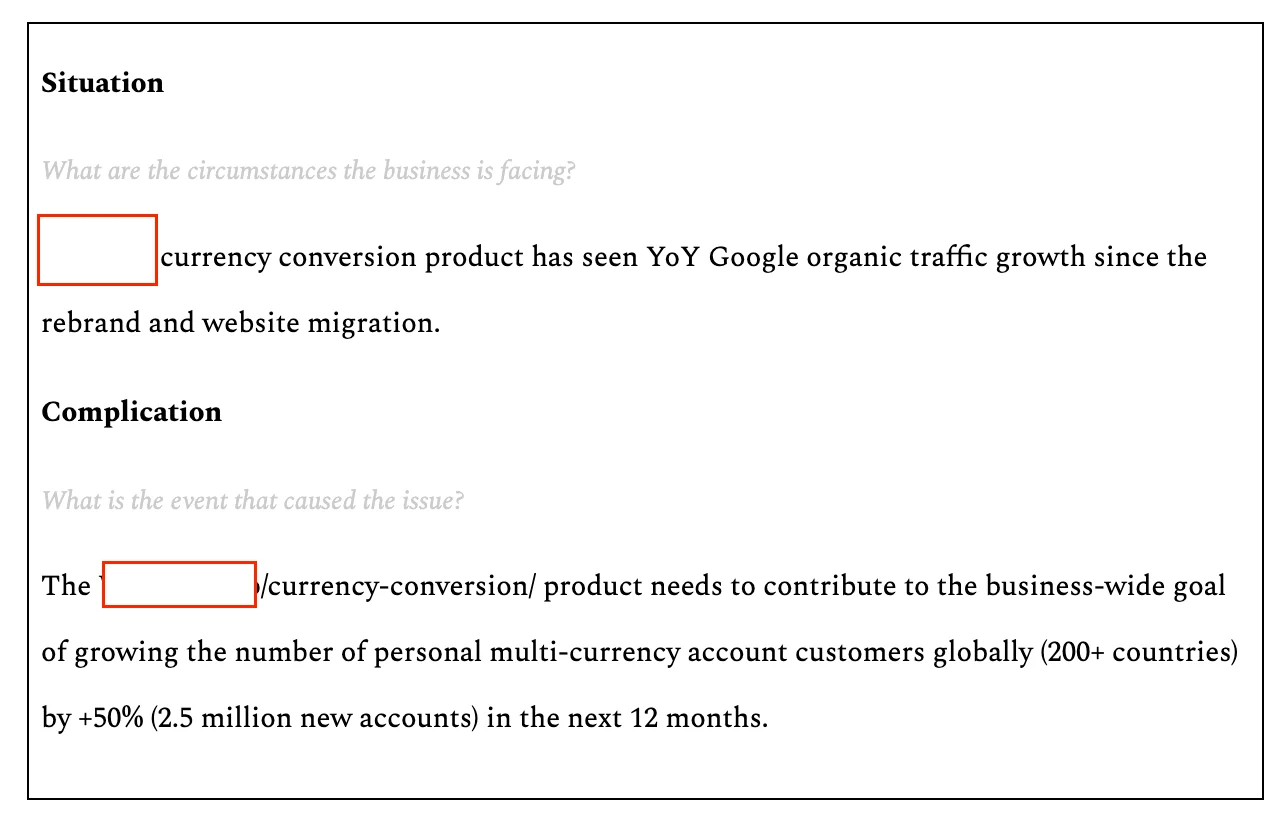
From the situation and complication, they then identify the key question that will help them overcome the business problem.
This isn't always easy. It sometimes takes time to find the right question that needs to be answered.
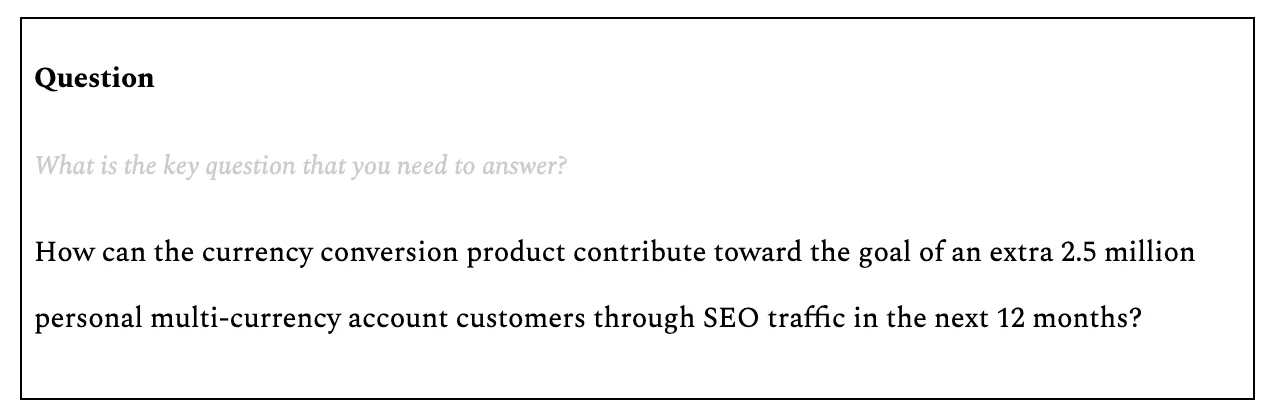
Once you've identified the situation, complication and question, a consultant will then use data and insights to answer the question.
#2 Write and structure your insights
A consultant now needs to do research and analysis to structure their insights.
They'd use data and information to identify an answer to the key question that the document or presentation must answer. They then use the MECE principle to group and summarise the data into 3-5 key insights. And the summary of these ideas will form the answer.
A consultant dumps their data, information and raw ideas into the notes section of the document. Trying to identify relevant ideas that will help answer the question. This requires speaking to other teams, digging into analytic data and making sure ideas are valid.
They summarise and label their notes once they have relevant data and valid ideas.
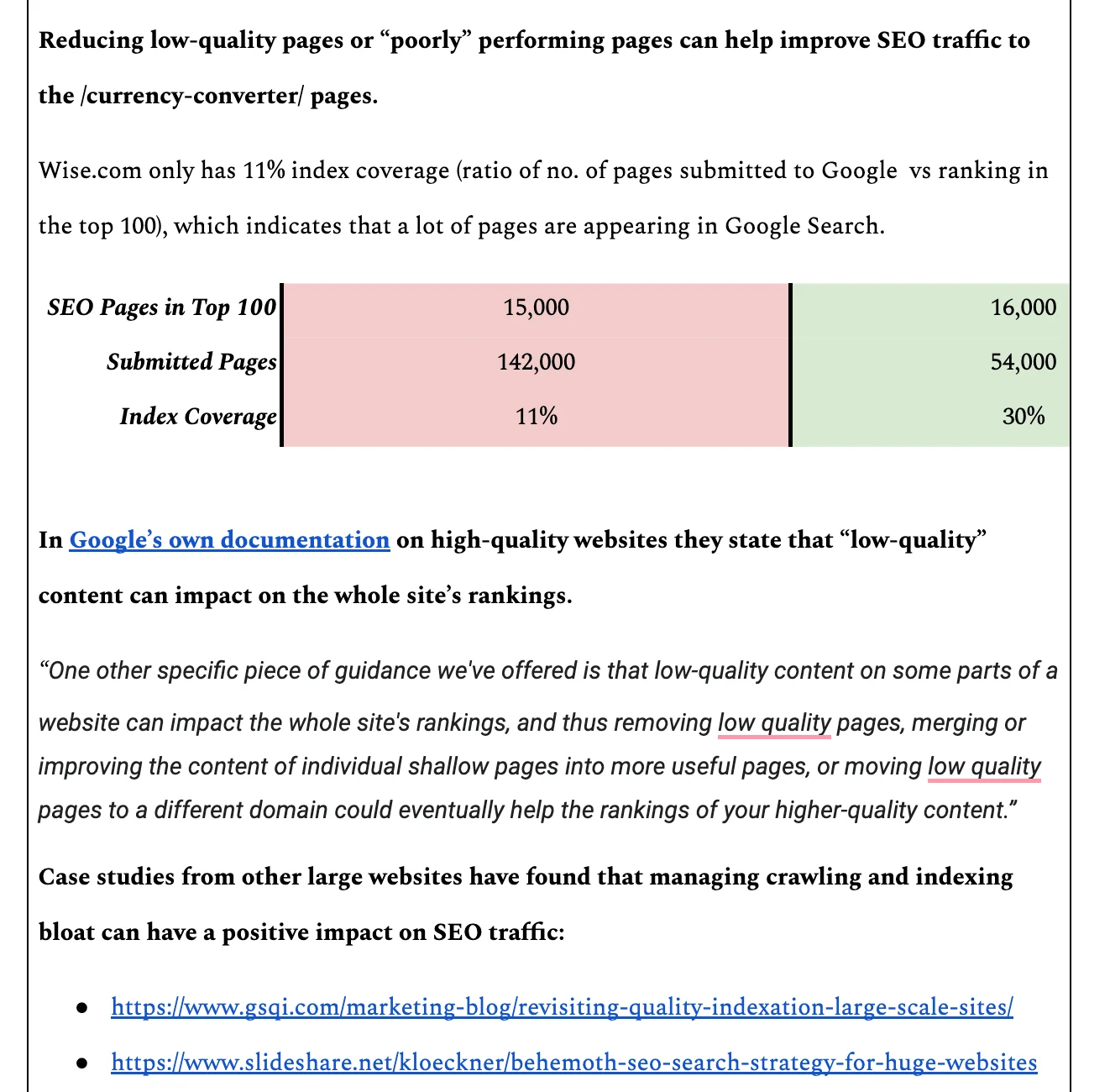
The consultant then summarises and groups labelled information into logical categories. These categories can then be used to form 3-5 key insights to answer the question.
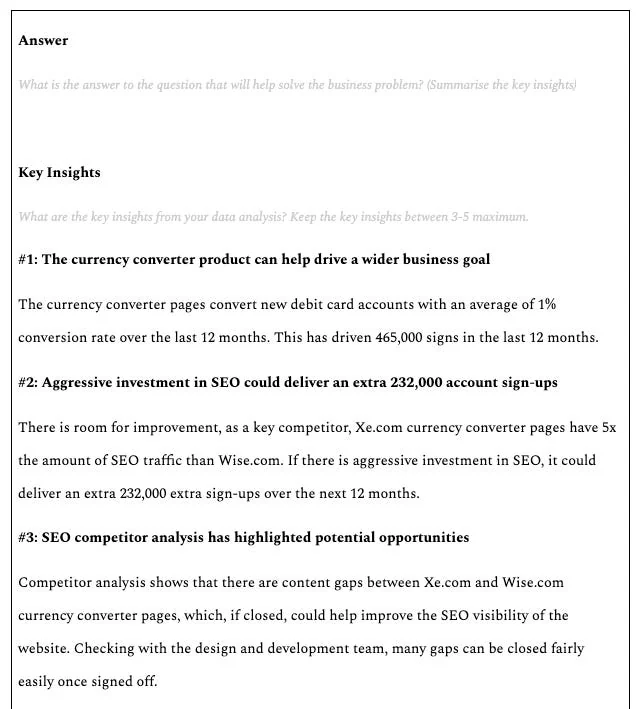
A consultant will then summarise the key insights into the answer to the key question. This will solve the business problem highlighted at the beginning of the process.
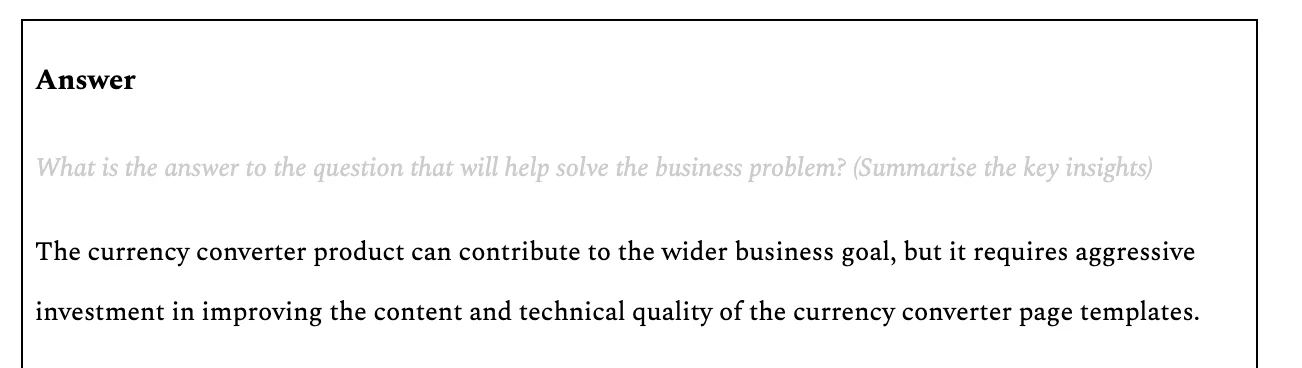
This process of labelling, summarising and grouping isn't quick.
It can take days or weeks to clarify the problem and key question. Only then does the consultant analyse the data to identify an answer.
#3 Communicate the main takeaway and key insights
A consultant will need to present the findings to higher management.
They must turn the written document into a presentation understood by busy managers.
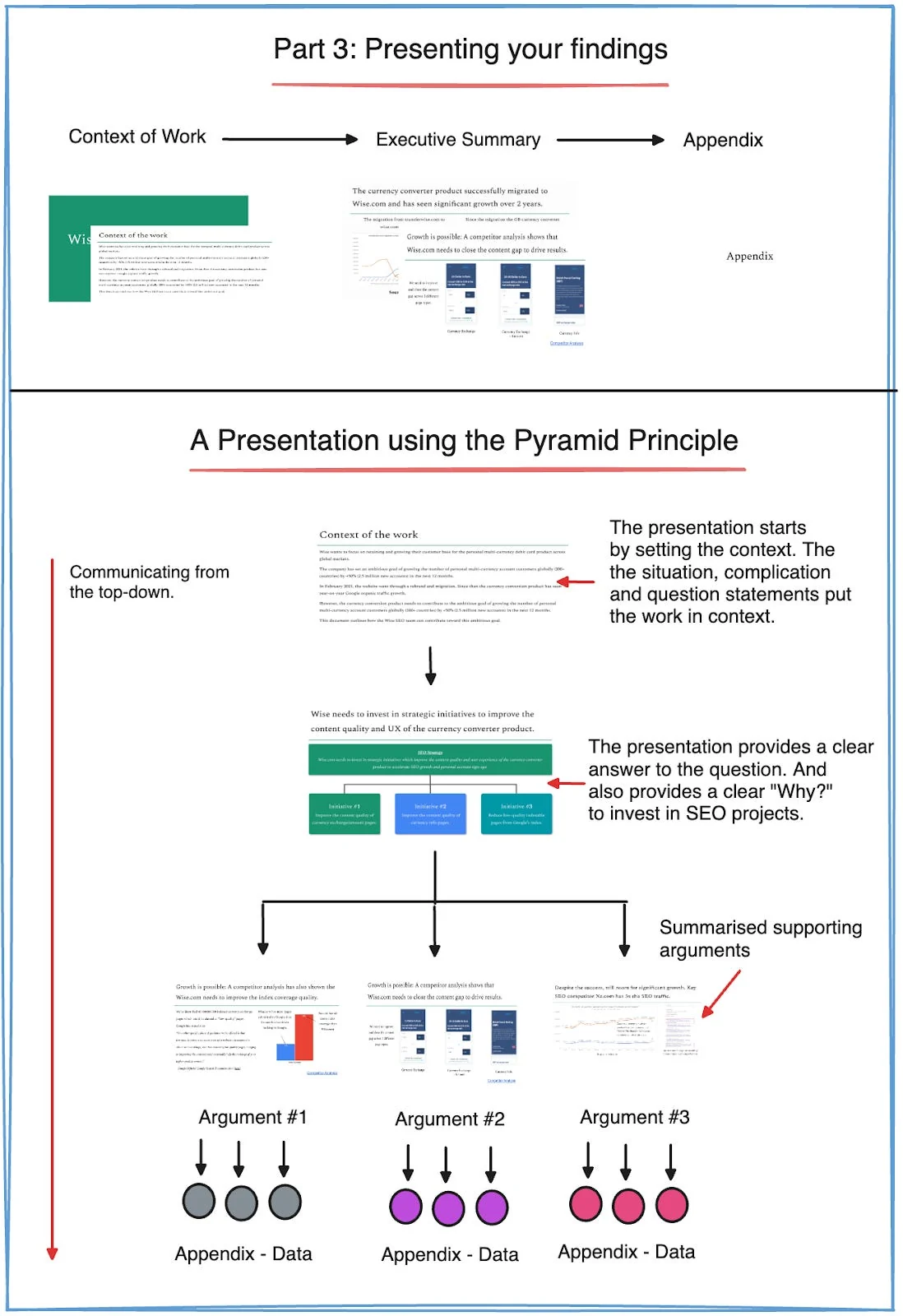
The consultant has already written their ideas into a logical pyramid structure, so building a presentation is simple.
The consultant starts by stating the situation, complication and question in one slide. This sets the context and communicates back the brief to the audience. To make it clear, the assignment has been understood.
Then, build the executive summary. This section answers the question and provides the supporting arguments in 5-10 slides. It's this section that makes or breaks the presentation.
The work in steps 1 and 2 ensures the presentation is bulletproof.
Finally, the appendix contains all the data and insights on which the answer and supporting arguments are based. Further details can be found here if needed.
🪵 SEO Use Cases of the Pyramid Principle
Here are some ways I've used the Pyramid Principle:
- Getting buy-in for SEO strategies
- Explaining technical SEO analysis
- Email Recommendations
- Google News and updates
- Improving slides in presentations
Let's look at each use case and how I use them.
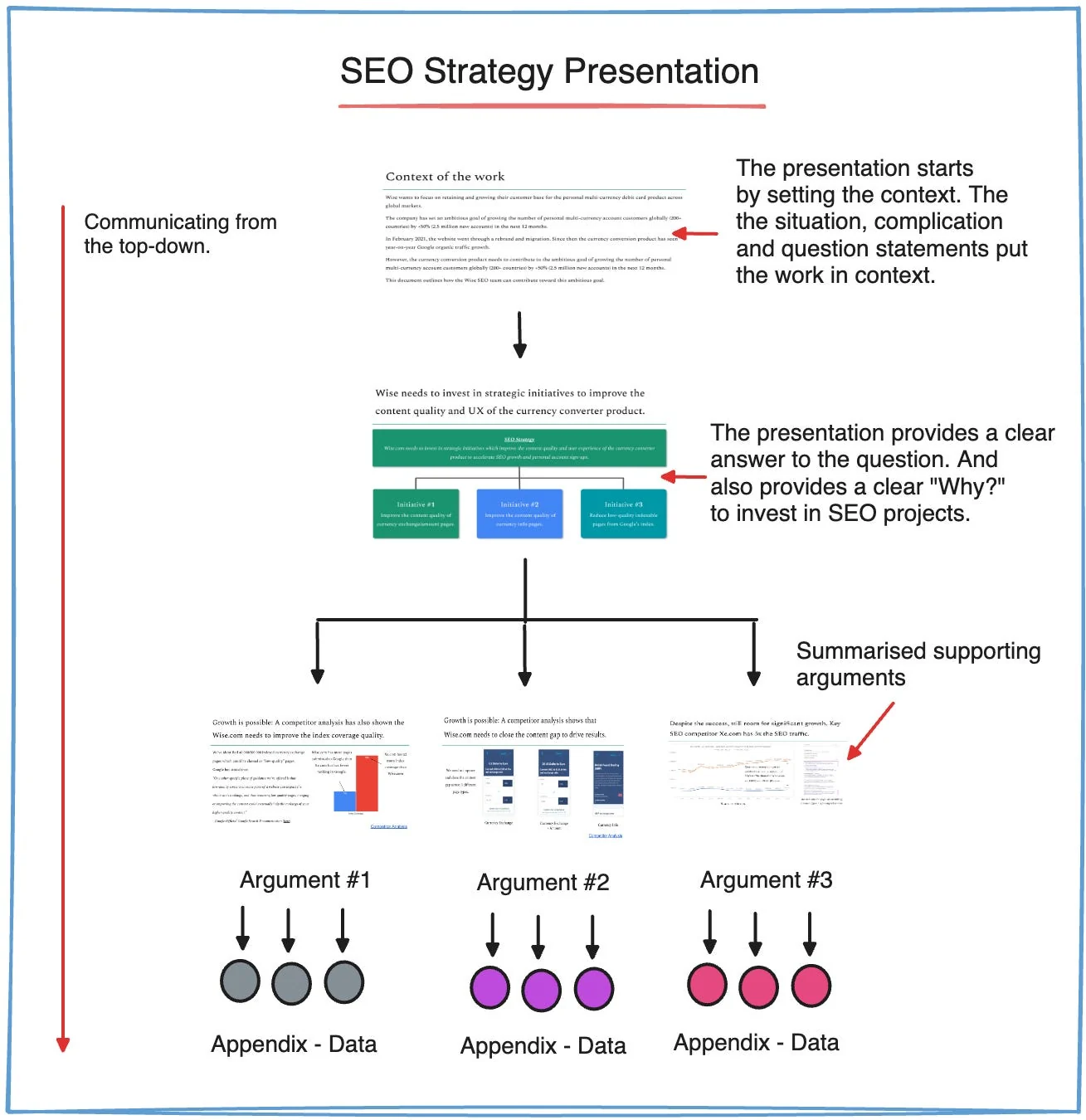
#1 Getting buy-in for your SEO strategy
Getting clients to buy into an SEO strategy is the perfect use of the Pyramid Principle.
An SEO strategy is always complex and messy to put together. It's even harder to communicate clearly to a room full of busy teams who don't care about the details. Especially when clients don't know the problem or question they want to solve.
The Pyramid Principle allows you to structure your recommendations in a way that can be easily understood by a non-technical audience.
#2 Technical SEO analysis
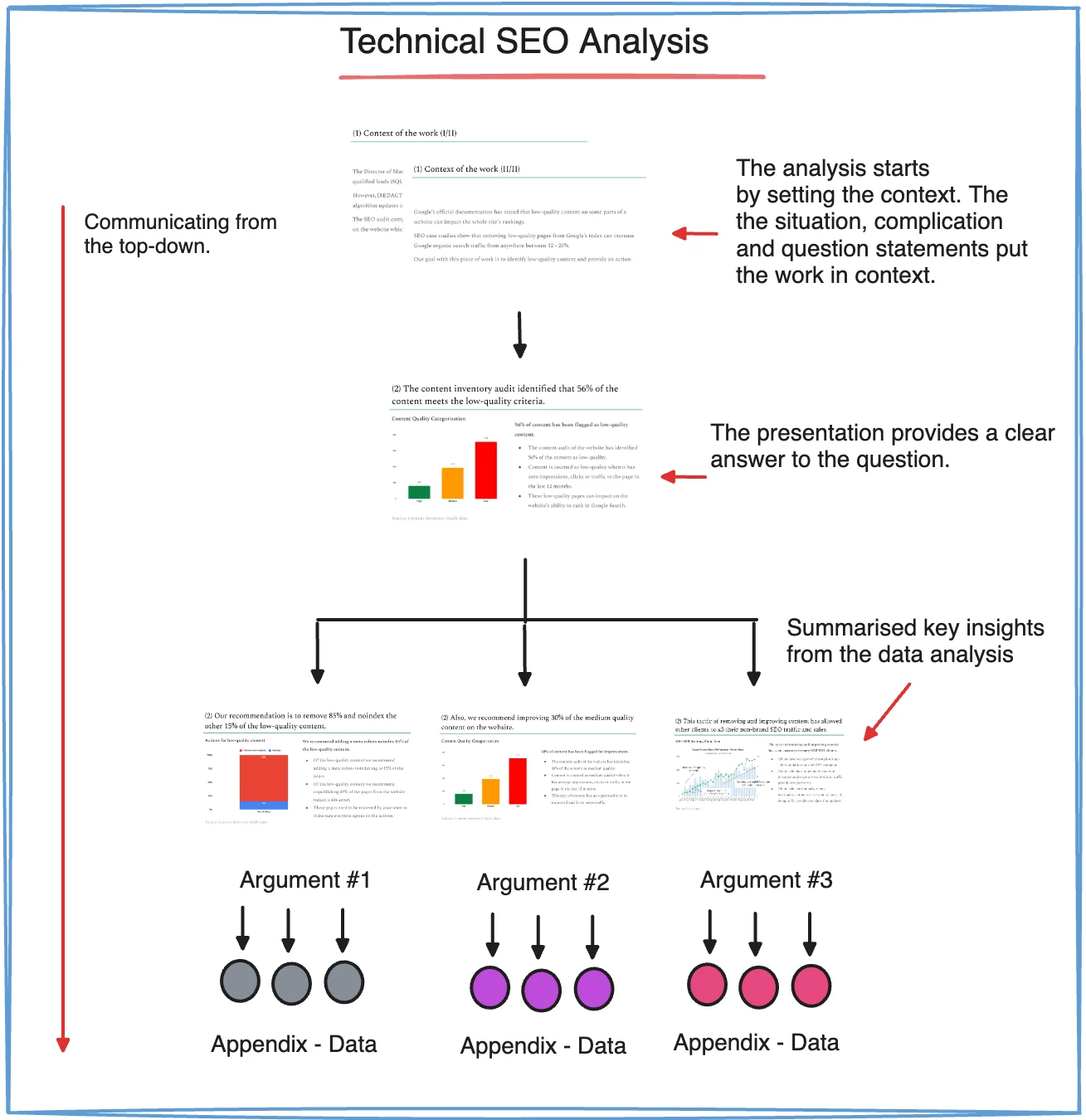
The Pyramid Principle can also communicate ad hoc technical SEO analysis to a non-technical audience. I've used the technique for:
- Content audit analysis
- Log file analysis
- Website architecture analysis
- Etc.
Communicating from the top-down using a slide deck makes it easier for clients to understand the results from your analysis and what actions they need to take.
#3 Email recommendation
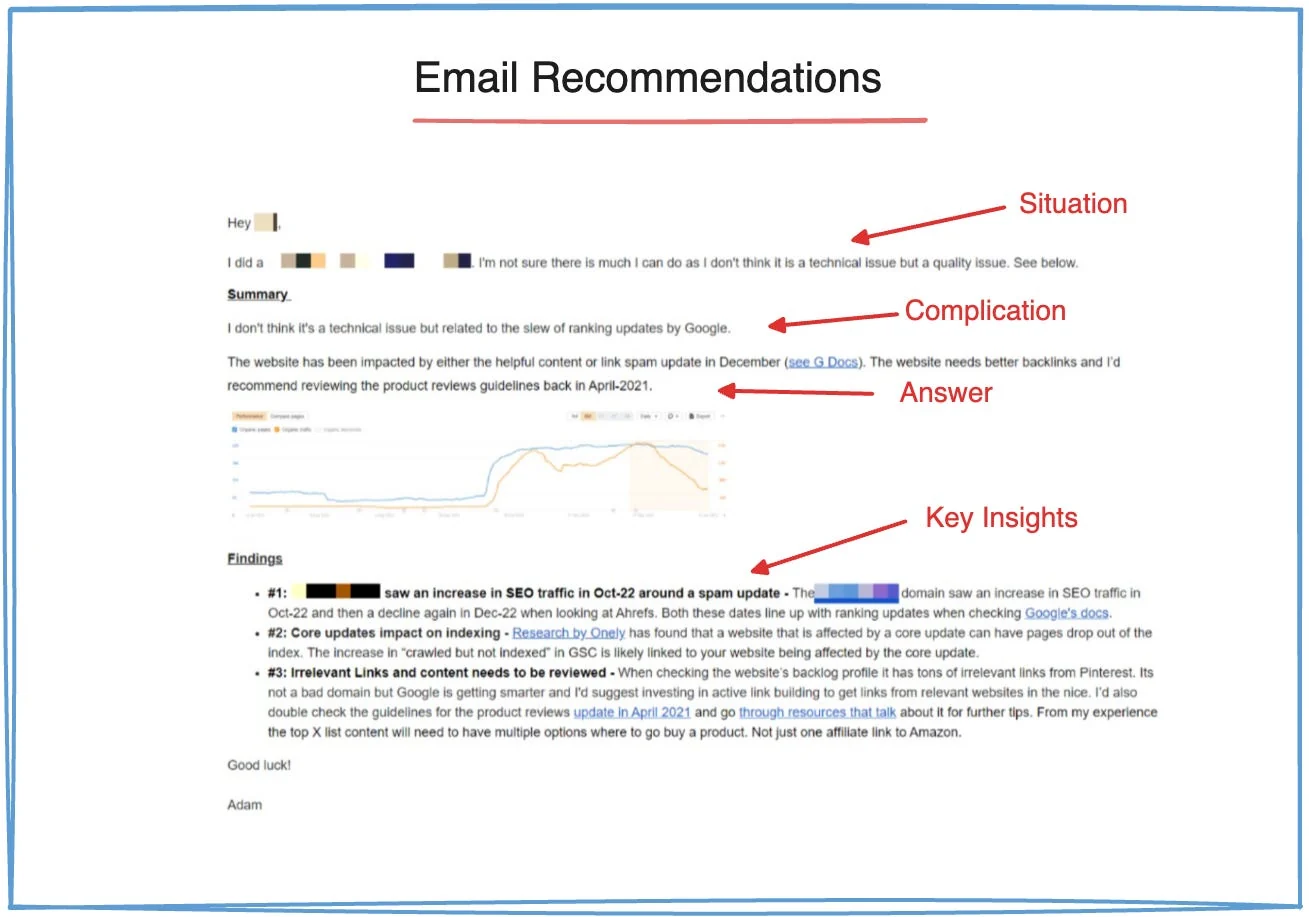
The Pyramid Principle is useful for emailing complex info to clients.
Starting with your main point in an email can help you get your point across faster. Then, you can group and summarise data/information to provide supporting arguments.
Allowing your reader to digest the email with a small amount of brain power.
#4 Google news and updates
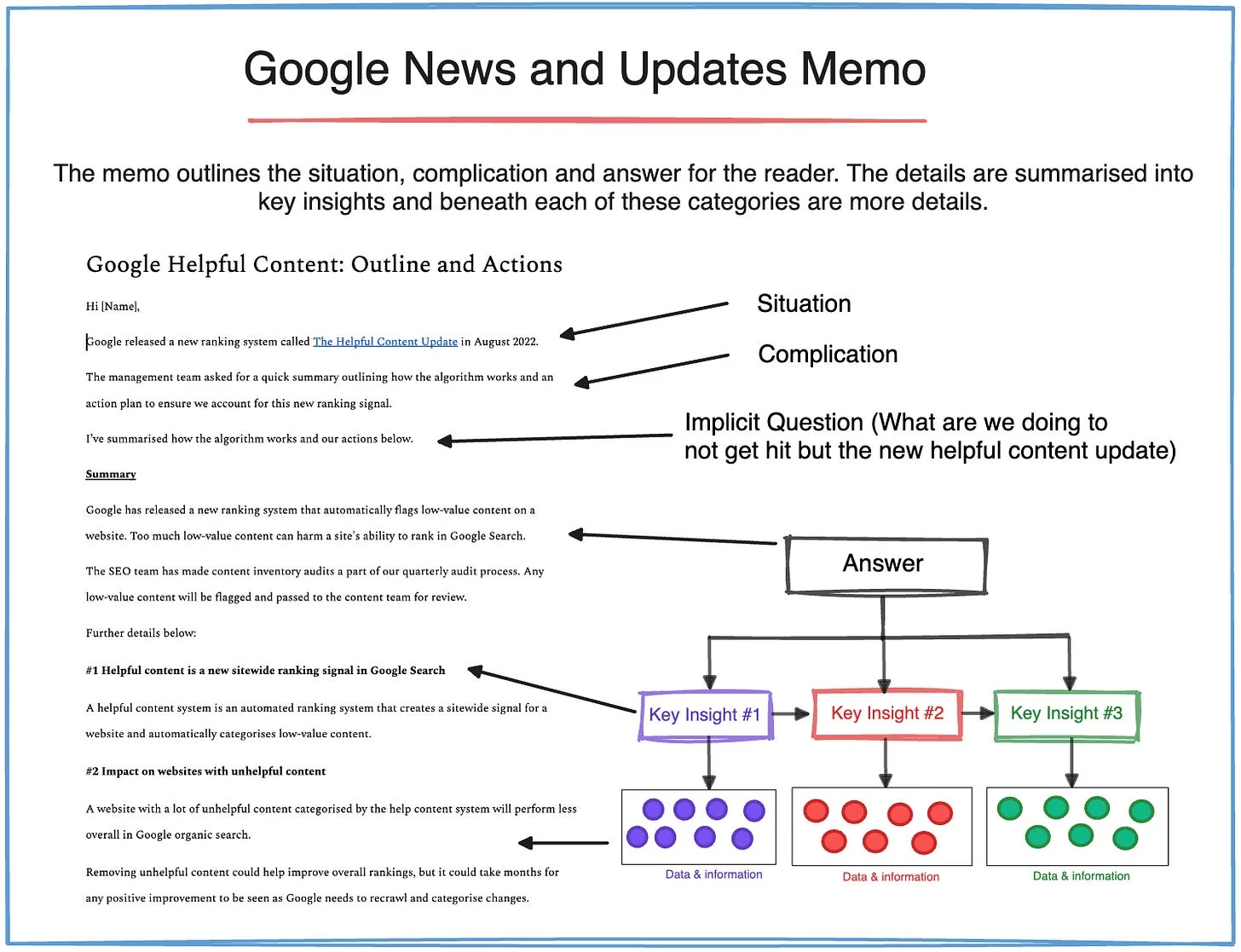
Google is always dropping news or algorithm updates. So, the Pyramid Principle can communicate complex topics to busy clients. Providing insights and actions in one email.
#5 Improving slides in presentations
Finally, the Pyramid Principle can help improve individual slides.
To make sure your point is clear across your deck. This is useful in ensuring details are grouped and summarised so the audience can digest ideas.
✅ The Pyramid Principle and SEO Communication
Learning to communicate is a key skill to getting things done in SEO.
The Pyramid Principle is a technique that can communicate complex ideas to busy teams. It's one of the most popular and effective ways to get your message across because:
- The mind will automatically group information into pyramid structures.
- Ideas communicated to an audience are easier to understand if sorted into pyramids.
- Any document or presentation is easier to understand if structured into a pyramid.
SEO experts must combine top-down and bottom-up thinking to present ideas to non-technical teams.
📚 Further Reading
Below are further resources if you're interested in learning more:
- The Pyramid Principle by Barbara Minto
- Structure Your Ideas: Pyramid Principle by Paul Millard
- The Pyramid Principle by Ameet Ranadive
