In my last post, I explained why you should still invest in SEO.
Google still drives the revenue, the traffic and the decisions. But that's only half the story.
A growing share of your target audience now asks ChatGPT, Gemini, Claude and Perplexity what to buy. And those tools answer with a shortlist of brands.
The data is clear: AI chatbots don't send much traffic, but they are starting to decide who makes the shortlist.
In this article, I'm going to explain why businesses should invest in AI search. Specifically, AI chatbots like ChatGPT, Gemini, Claude and Perplexity.
I won't cover Google's AI Overviews or AI Mode. I covered those in the last post.
Let's dive in.
Key takeaways
- Bottom line - Although AI search is growing, it lacks volume. SEO is still your main source of revenue and referral traffic, but investing in AI search gets you ready for the next phase of search.
- AI search tools have gone mainstream - Studies show 49% of US adults have used an AI chatbot, and ChatGPT has 900 million weekly users. But Google search remains the dominant search engine.
- AI search is where many software buyers start - Studies show that 51% of B2B software buyers now start their research in an AI chatbot. If you aren't shortlisted in the B2B software market, you often aren't considered.
- AI traffic is small but growing fast - AI is about 1 in 200 website visits. But it's the fastest-growing channel.
- AI visitors are engaged - Companies are finding that AI search visitors convert at a higher rate than traditional search visitors. Just at much lower volumes.
- AI search can drive real revenue - Case studies from companies have shown that AI search traffic can drive real revenue for a business. But like most acquisition channels, results can vary by industry.
- Your reputation decides who gets recommended - In AI search your reputation matters. 85% of brand mentions in AI answers come from other websites, not your own.
- Competitors are investing but few can prove it works - Although 89% of companies raised AI search spend, only 24% can prove ROI. Being the first to figure out AI search and reporting gets you ahead of the game.
1. AI search tools have gone mainstream
AI chatbots have gone mainstream in two years.
Pew Research Center surveyed 5,119 US adults in June 2026:
- 49% have used an AI chatbot, up from 33% in 2024.
- 24% use one every day.
- 42% use chatbots to search for information.
ChatGPT alone passed 900 million weekly users in February 2026, according to OpenAI.
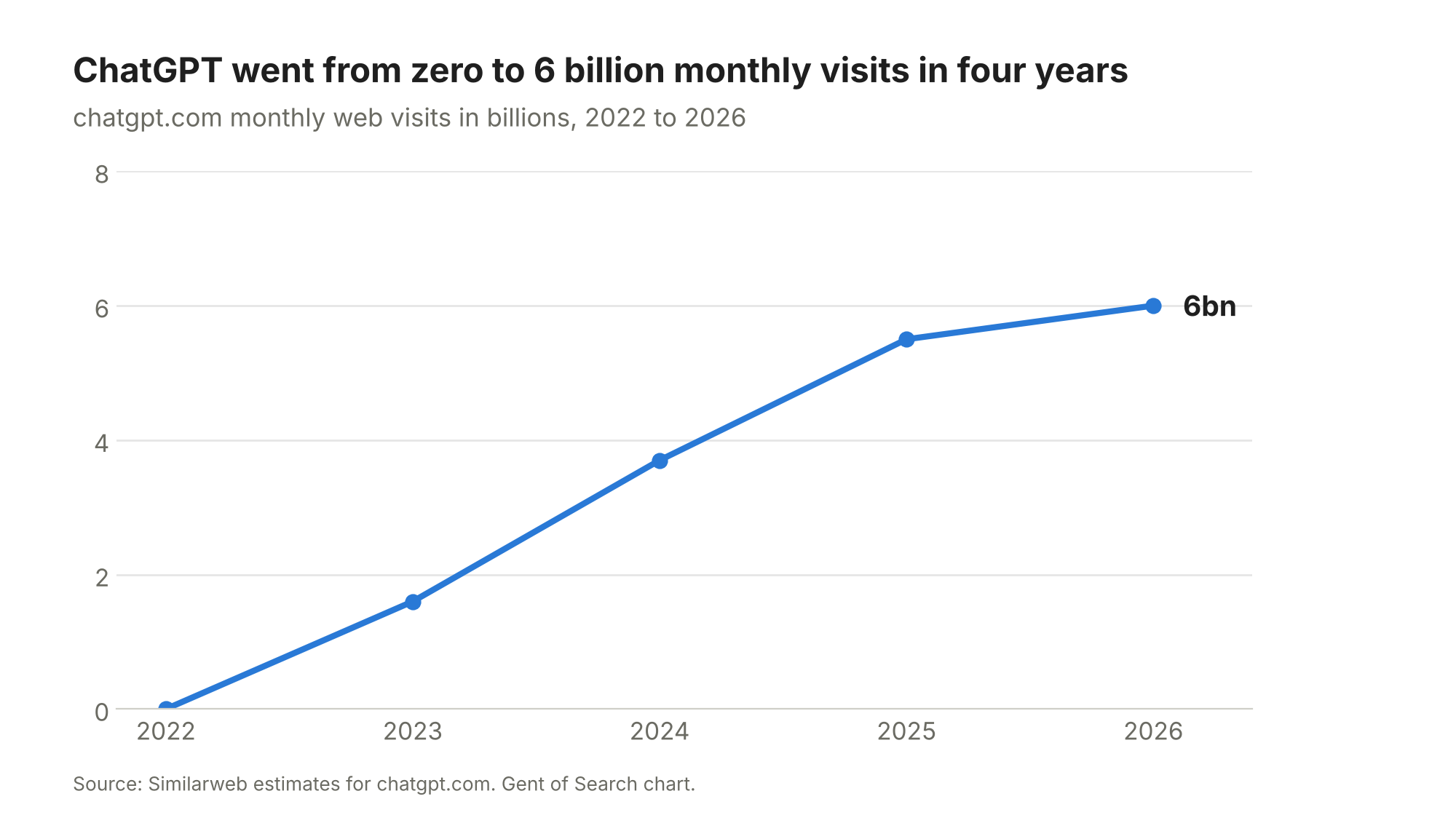
But it's not just ChatGPT anymore. Similarweb's 2026 Generative AI Landscape shows visits to AI tools grew 70% year on year, to 9.5 billion a month. And the market is splitting:
- ChatGPT fell from about 76% to about 53% of AI chatbot web traffic.
- Gemini rose to about 28%.
- Claude rose to about 9%.
People are also using these tools to shop.
Profound's data shows commercial-intent ChatGPT conversations rose from 13.9% to 19.2% in a year (7.5 million US conversations).
However, despite its rapid growth, Google Search is still far bigger.
Several studies from SparkToro, Datos and Similarweb have found that Google Search is still the dominant search engine, even when you take into account the growth in AI Search.
- Search volume: Google says it handles more than 5 trillion searches a year. SparkToro estimates ChatGPT handles about 37.5 million search-like prompts a day. That puts Google at roughly 373 times ChatGPT's search volume.
- Search share: in Q4 2025, Google handled 73.7% of US desktop searches across 41 sites. All AI tools combined handled 3.2% (SparkToro and Datos).
- 95% of ChatGPT users still use Google, according to Similarweb. AI chatbots sit alongside Google. They don't replace it.
There is no denying AI chatbots are growing fast. But Google is still the dominant search engine.
What does this mean for your business?
Your customers are already asking AI chatbots for advice. Half of them, and a quarter every day.
And they don't all use ChatGPT. Gemini and Claude are growing fast, so being visible in just one chatbot isn't enough.
2. AI search gets you recommended on the shortlist
The biggest reason to invest in AI Search isn't traffic. It's being recommended.
People don't ask a chatbot for ten blue links. They ask for a recommendation. And they get a short list of brands that match a specific set of criteria.
McKinsey surveyed 1,927 US consumers in 2025. 50% now use AI-powered search, and 44% of those users say it's their primary source for buying decisions.
In B2B, the shift is even faster:
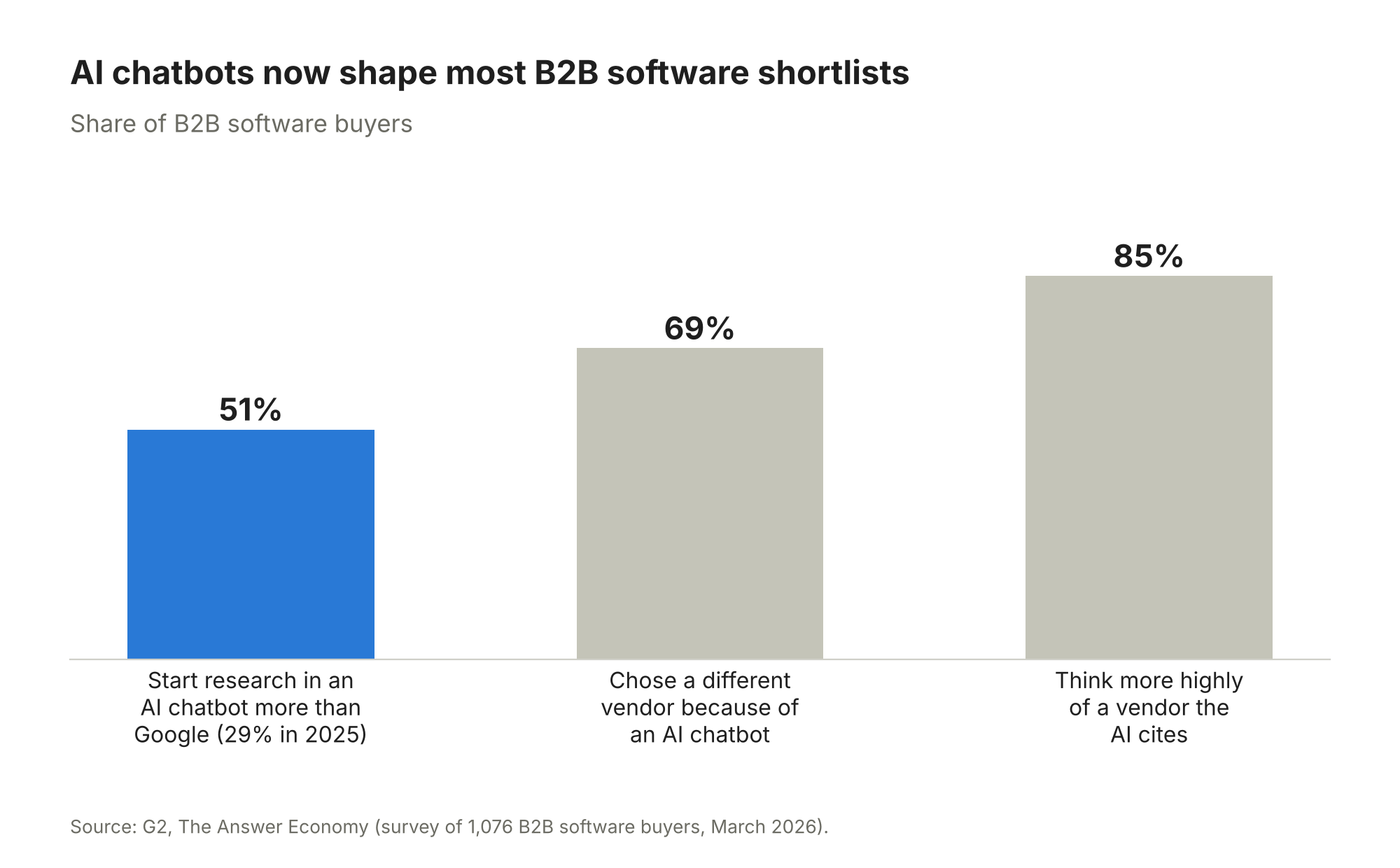
- G2: 51% of B2B software buyers now start their research in an AI chatbot more often than Google, up from 29% in 2025. 69% chose a different vendor than they planned because of a chatbot. 85% think more highly of a vendor the AI cites.
- Forrester: 94% of business buyers use generative AI in their buying process (nearly 18,000 buyers). When they use AI instead of search, they're one-tenth as likely to click through to your website.
- Wynter: in a survey of 200 software buyers, 62.7% added another vendor to their list because of AI. 62% of buyers who chose a vendor saw it in the first AI answer.
In the ecommerce industry, consumers are starting to behave in the same way.
In a Profound study of ChatGPT shopping tasks, 92.8% ended without a click to the open web. The brands people chose had a 24% share of voice in the answers, against 11% for the brands they passed over.
The decision happens inside the answer. Not on your website.
That said, not every chatbot conversation is about buying.
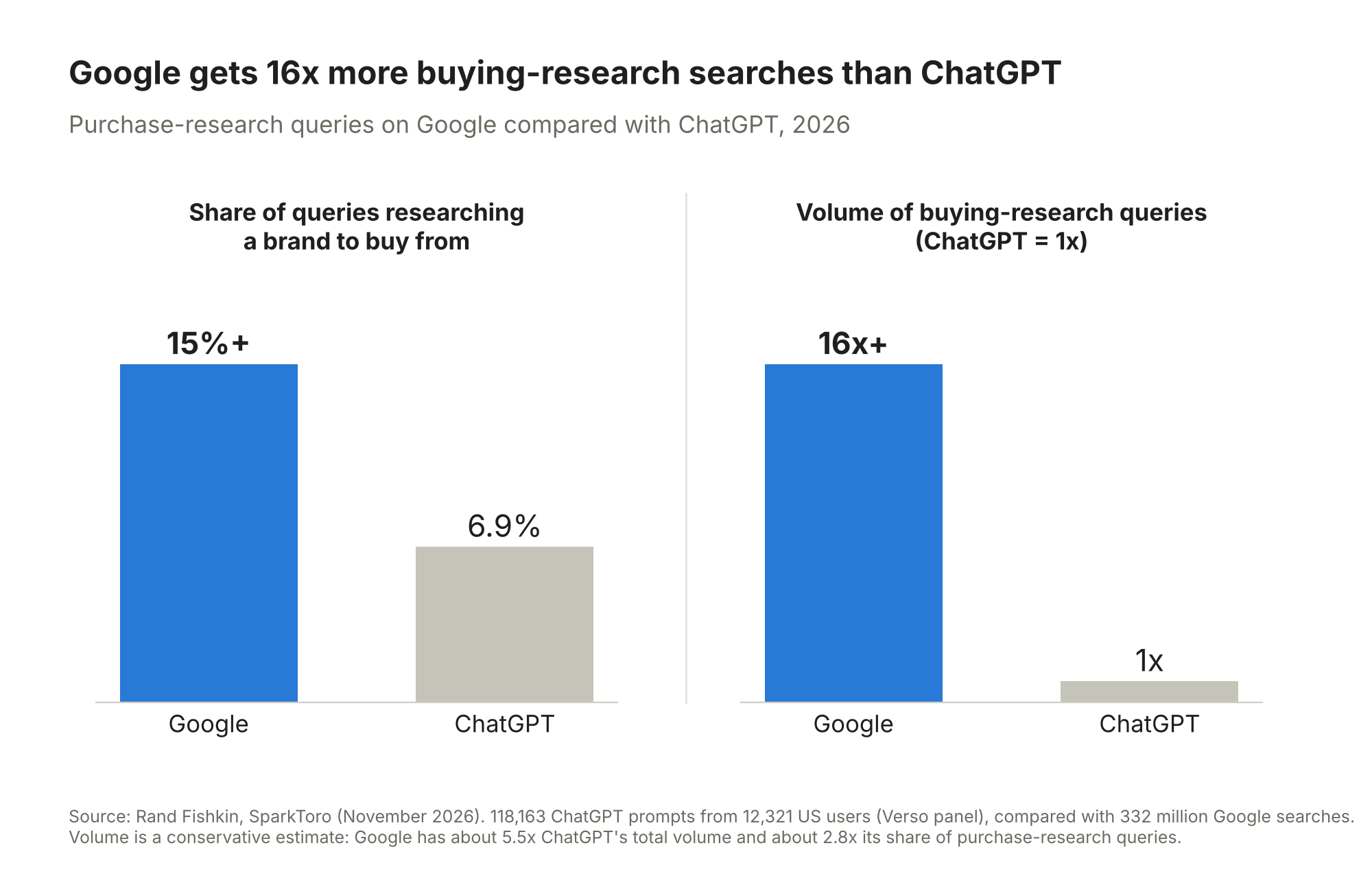
SparkToro analysed 118,163 ChatGPT prompts from 12,321 US users in 2026. Only 6.9% involved researching a brand to buy from, against over 15% of Google searches.
Rand "Yeehaw" Fishkin estimates people make buying-research searches on Google at 16 times or more the rate they do on ChatGPT.
The shortlist effect is real. It matters most in considered purchases. But buyers still check their answers on Google.
In the Wynter survey, 48% of software buyers Googled the vendor after their AI chat, and 72.5% visited vendor websites. G2 found 61% of buyers use AI chatbots alongside Google, not instead of it.
AI builds the shortlist. Google is where buyers go to check it.
What does this mean for your business?
If a chatbot doesn't name you, you often aren't considered at all.
Your buyer won't see your website, your reviews or your sales team. They'll see three or four competitors, and pick one.
Being in the answer in AI Search tools is the new first page of Google.
3. AI chatbot traffic is small, but it's the fastest-growing channel
AI chatbots don't send much traffic to your website.
Studies show AI search referrals are small compared with Google:
- Conductor: AI referrals were 1.08% of website traffic across 13,770 domains. ChatGPT drove 87.4% of those referrals.
- Similarweb via Growth Memo: AI referrals reached 2.85% of SEO traffic in the US, across 10,000 domains. That's roughly 1 in 200 visits.
- Marie Haynes: across 100 sites and 145 million sessions, ChatGPT sent 0.62% as many sessions as Google organic.
But despite its small size, many studies show it's growing faster than any other channel:
- Adobe: AI traffic to US retail sites grew 71% year on year in September 2026. That's up 1,772% since October 2024.
- Adobe: AI shopping traffic is forecast to grow 130% over the 2026 holiday season.
- Microsoft Clarity: AI referrals grew 155.6% in eight months, against 24% for search, across 1,200+ publisher sites.
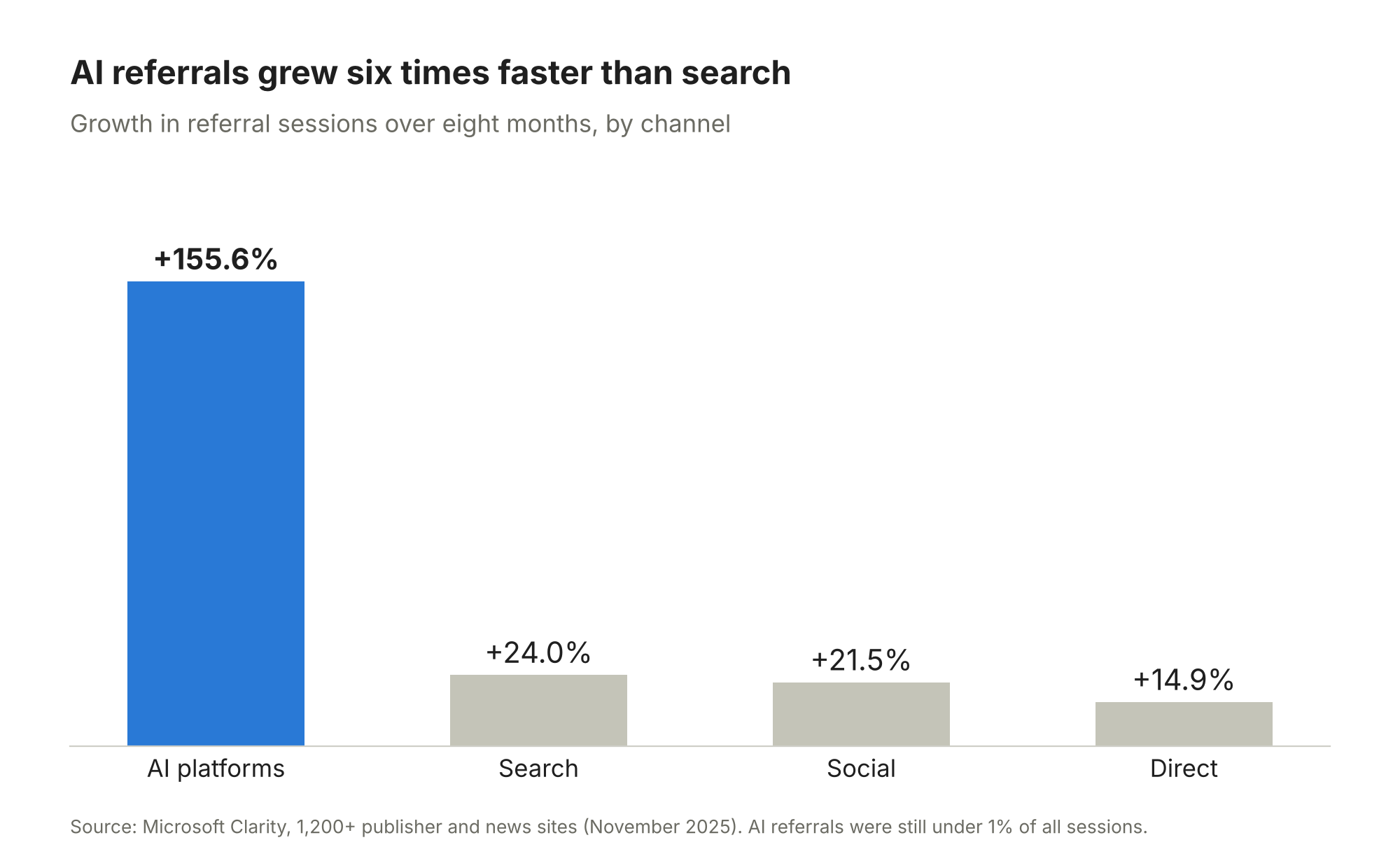
But remember: The growth rates for AI Search look huge because the starting point is tiny.
Compare that with Google organic search:
- SE Ranking: across 101,574 websites, organic search drove 42.75% of traffic, against 0.32% from AI platforms. That's roughly 134 visits from search for every one from AI.
- Conductor: across 13,770 enterprise domains, organic search drove over 33% of sessions, against 1.08% from AI.
- Alphabet: Google Search revenue grew 12% to $63.35 billion in Q3 2026, and Google said query growth was the highest in five years.
AI search isn't a big traffic driver. But it's the fastest-growing channel year on year.
What does this mean for your business?
Don't invest in AI chatbots to replace your Google traffic. They won't.
In Marie Haynes' study, Google organic sent around 160 visits for every one from ChatGPT. This means you need to keep investing in SEO as your base.
But AI is the fastest-growing source of visitors. Building visibility now puts you ahead before the channel gets crowded.
4. AI search sends engaged visitors
Visitors who land on your website from AI Search tend to arrive ready to buy.
Why?
Because they've already asked their questions, compared options and read the pros and cons. By the time they click, the research is done.
Many studies have shown this behaviour:
- Adobe: in September 2026, AI visits to US retail sites converted 90% better and earned 83% more revenue per visit than other traffic. A year earlier, they converted 9% worse.
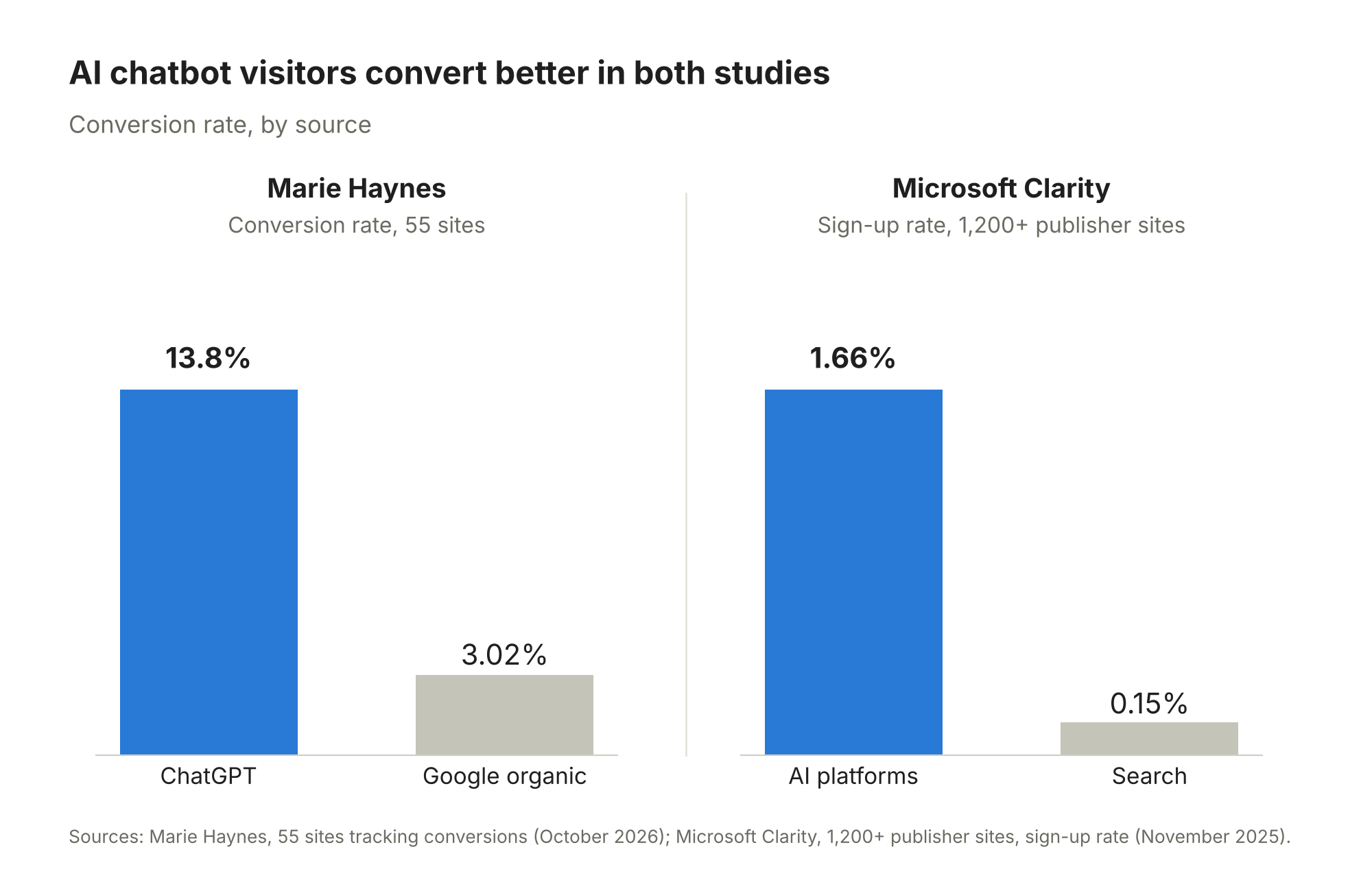
- Microsoft Clarity: across 1,200+ publisher sites, AI visitors signed up at 1.66%, against 0.15% from search.
- Marie Haynes: ChatGPT visitors converted at 13.8%, against 3.02% for Google organic, across the 55 sites tracking conversions.
But the evidence isn't one-sided.
The only peer-reviewed study, Kaiser and Schulze in Marketing Science, looked at 973 ecommerce sites from August 2024 to July 2025. ChatGPT traffic converted 13% worse than organic search.
Two details matter:
- ChatGPT's conversion rate improved every month.
- ChatGPT beats organic search on sites selling complex products.
The volume of visitors matters too.
In Marie Haynes' study, Google still drove 96.5% of conversions, 27 times more than all AI chatbots combined.
What does this mean for your business?
A visitor from ChatGPT is often worth more than a visitor from Google. But you'll get far fewer of them.
The value is highest when buyers need to compare. Think software, finance, travel and expensive products.
If you sell something people research before buying, AI chatbots are worth the investment.
5. AI Search can drive real revenue
AI search drives revenue for some industries with the right audience.
For some companies, AI chatbots are already a top acquisition channel:
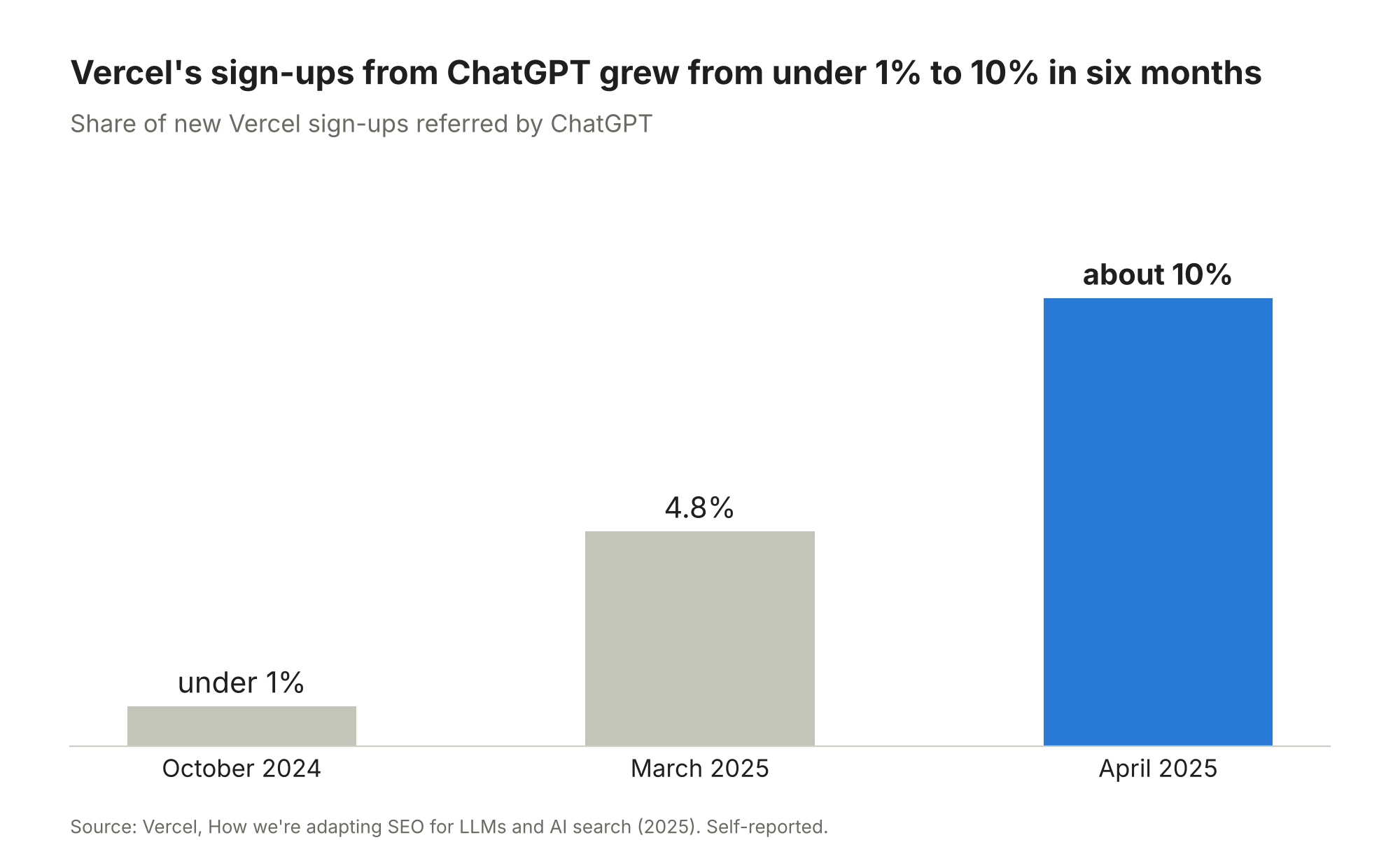
- Vercel: ChatGPT referred about 10% of new sign-ups in April 2025. That's up from under 1% six months earlier.
- Tally: AI search became its number one acquisition channel. Over 10,000 new users a week find it through ChatGPT or Perplexity, and the bootstrapped form builder crossed $5M ARR.
- Webflow: AI-attributed sign-ups grew from 2% to about 10%, and AI traffic converted 6x better than other traffic.
- Ramp: attributes 30% to 40% of its direct traffic to answer engines.
These are self-reported, and most are software companies with tech-savvy audiences.
But results can vary depending on your industry and market.
OpenAI launched in-chat checkout in ChatGPT in September 2025, then retired it in March 2026. Walmart found purchases inside ChatGPT converted about 3x worse than sending shoppers to its own site.
People discover brands in the chat. They still buy on your website.
What does this mean for your business?
Investing in AI search can drive real revenue for certain businesses.
AI chatbots can become a meaningful source of new customers, especially for software and products people compare.
But AI search isn't going to be the top acquisition channel for every business.
6. AI Search = your reputation on the web
AI chatbots don't just read your website.
They read what everyone else says about you across the internet:
- AirOps with Kevin Indig: 85% of brand mentions in AI search come from third-party pages, not the brand's own site. Brands are 6.5x more likely to be cited through other websites than their own.
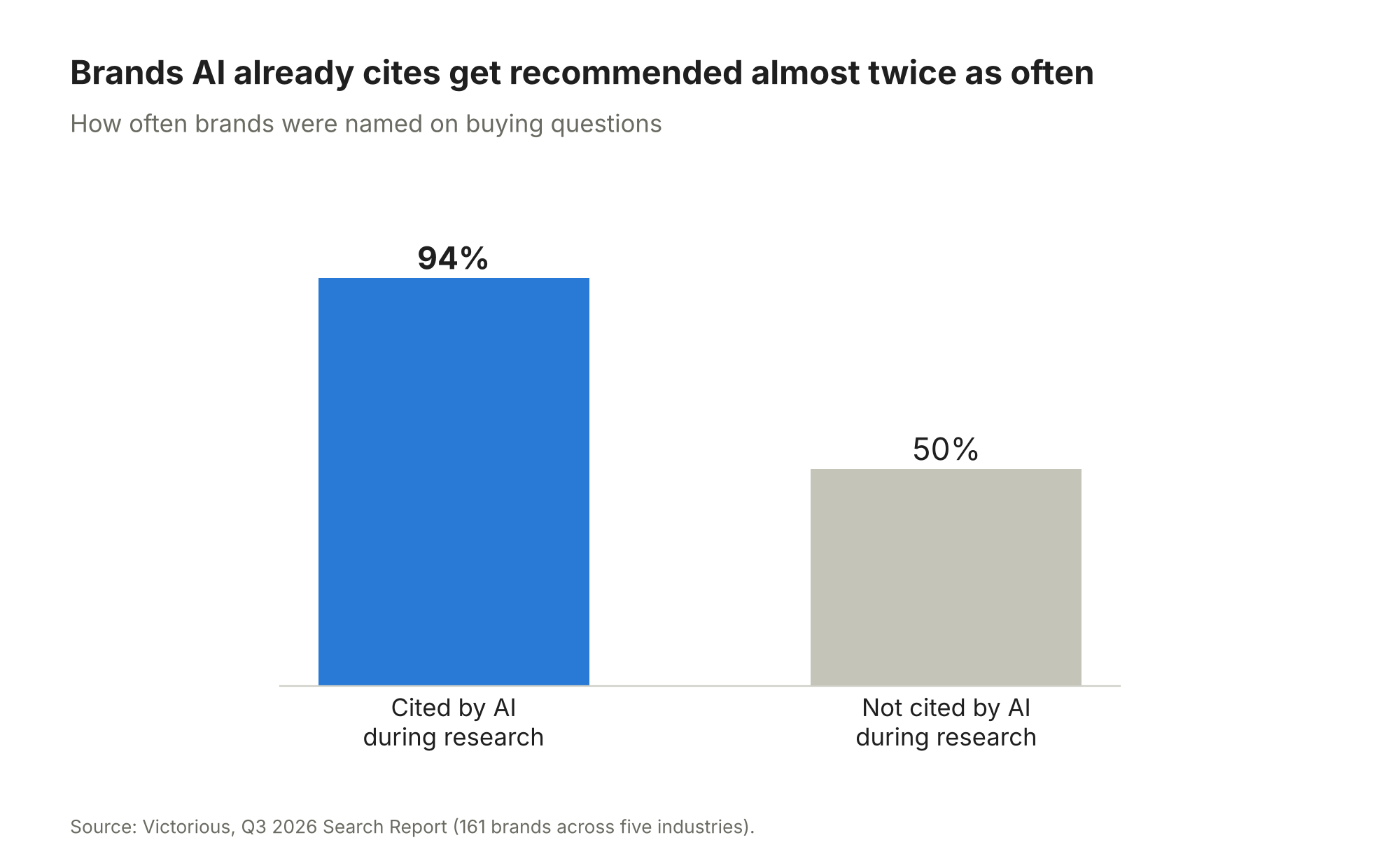
- Victorious: brands that AI cited during research were named on buying questions 94% of the time, against 50% for brands it didn't cite (161 brands).
- Peec AI: ranking first in a "best X" list lifted brand visibility in AI answers by up to 16.5 percentage points in B2B SaaS.
The sources AI trusts also change fast.
After ChatGPT switched to a new default model in August 2026, Peec AI's data showed its "best X" list citations halved, from 16.2% to 7.3%. Product page citations rose from 13.8% to 20.1%.
And each chatbot gives different answers.
Only 2.37% of cited pages appear in ChatGPT, Perplexity and Google's AI for the same prompt. Only 2.2% of citations stay the same across three runs of the same question.
But off-page SEO or Digital PR tactics are just part of the puzzle. Good SEO still helps you get into the answer.
AirOps found the first page a chatbot retrieved was cited 58% of the time, against 14% for pages further down. Kevin Indig estimates SEO and AI search work overlap by 70% to 80%.
If you rank well on search engines, you're more likely to be cited by AI.
But AI Search experts like Gaetano DiNardi argue GEO is a reputation problem, not a tactics problem. He warns that paid brand mentions can look like authority without building it.
You can't trick your way into the answer. You have to earn it.
What does this mean for your business?
Investing in AI search is an investment in your online reputation.
Reviews, "best of" lists, Reddit, YouTube, press coverage and industry sites all count toward your appearance in an answer in AI Search.
But remember your own website still matters.
Good SEO practices that help you rank in search results can also help you appear in AI search. Keep product pages and comparison content clear, up to date and ungated so AI can easily read them.
Remember AI search = reputation management.
7. Your competitors are investing, but few can prove it works
Businesses are already moving their budgets into AI search.
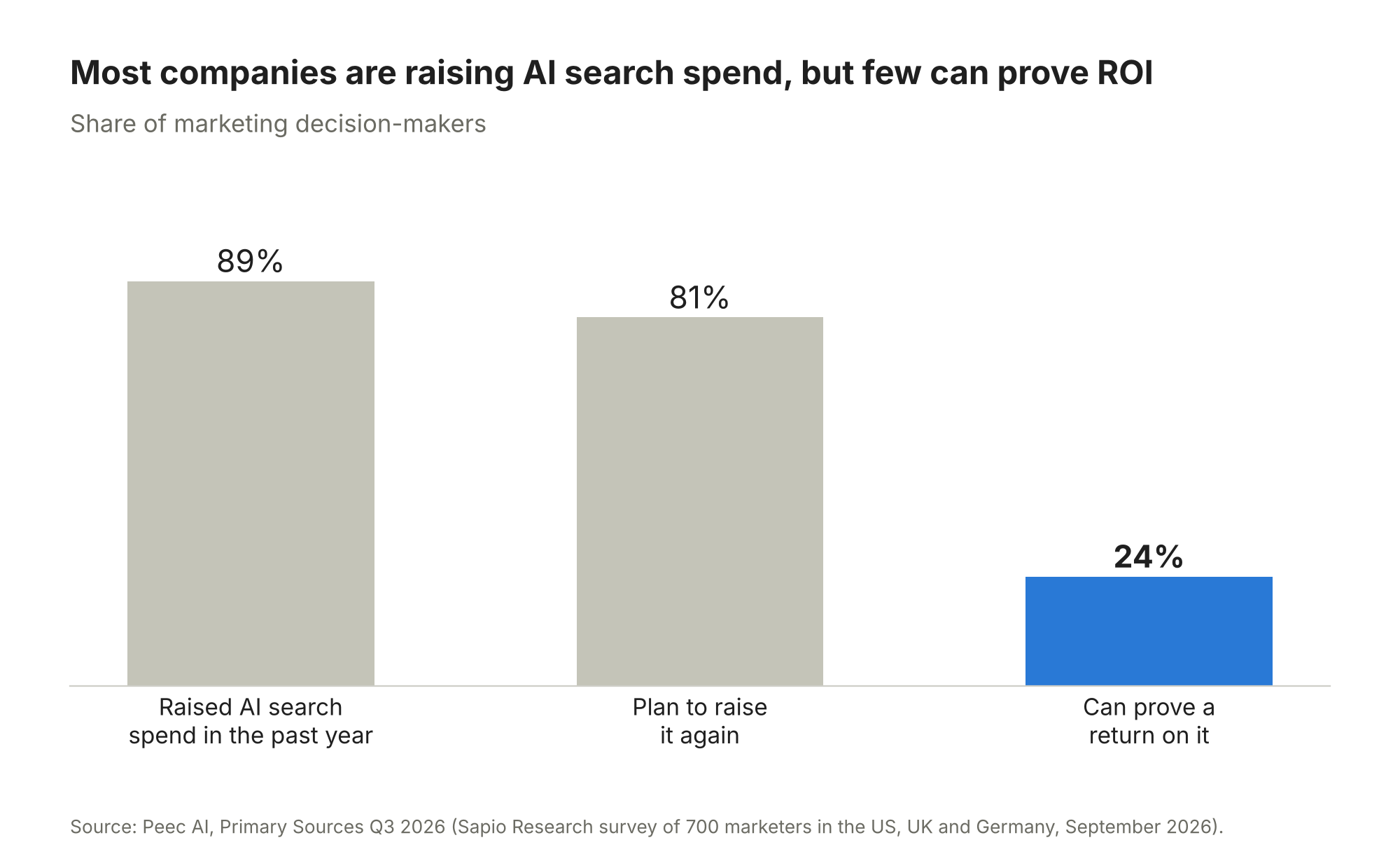
Peec AI's Primary Sources report surveyed 700 marketing decision-makers in the US, UK and Germany in September 2026:
- 89% raised their AI search spend in the past year.
- 81% plan to raise it again.
- Only 24% can prove a return on it (19% in the UK).
The top reason for investing? Competitors showing up in AI answers (43%).
Measurement is the main problem. Over 40% of 599 marketers in a Growth Memo survey said it's their biggest AI search challenge. Many AI visits arrive without a referrer, so they don't show up as AI in analytics.
But there's an advantage in that. Teams with dedicated owners reported ROI more often, 35% against 15%.
Most businesses are spending on AI search. Few are doing it properly.
What does this mean for your business?
Investing in AI Search means keeping up with the competition.
But here is the most important thing to remember: Most companies can't yet prove a return on their investment. Only 24% can. If you can build a programme that grows visibility and proves ROI, you'll get ahead of the competition.
Judge your investment on being able to connect AI search visibility to sales.
Summary: Why Invest in AI Search
AI chatbots won't replace Google.
But they're starting to decide which brands buyers consider at the start of the journey. Even if, for some industries, they send low volumes of traffic and sales.
Let's quickly summarise why AI search is worth investing in:
- AI search tools have gone mainstream. 49% of US adults have used an AI chatbot, and ChatGPT has 900 million weekly users. But Google still handles 73.7% of US desktop searches, against 3.2% for all AI tools.
- AI gets you on the shortlist. 51% of B2B software buyers start in an AI chatbot, and 69% changed vendor because of one. Only 6.9% of ChatGPT prompts involve buying research, so it matters most for considered purchases.
- AI traffic is small but growing fastest. AI is about 1 in 200 website visits. But AI referrals grew 155.6% in eight months, against 24% for search.
- AI visitors are often worth more. Adobe found AI visits converted 90% better than other traffic. But the only peer-reviewed study found ChatGPT converted 13% worse, so test it for your business.
- AI search can drive real revenue. Vercel gets about 10% of sign-ups from ChatGPT, and AI is Tally's number one channel. Results vary by industry.
- Reputation decides who gets recommended. 85% of brand mentions in AI answers come from other websites. Brands AI already cites get named 94% of the time, against 50% for those it doesn't.
- Competitors are investing. 89% of companies raised AI search spend, but only 24% can prove ROI. Measure properly and you'll get ahead.
But don't take the budget away from Google to pay for it. Organic search still sends roughly 134 visits for every one from AI, and Google still drives most conversions.
Keep investing in SEO. And create a separate AI search budget.
