A lot of businesses are hesitant to invest in the SEO channel.
The perception is that the rise in popularity in AI tools like ChatGPT is replacing Google Search. And there are constant reports from our own industry that Google's own AI features means fewer clicks to websites.
But industry data tells a different story: Google Search is still where people go for answers, and it's still growing.
In this article, I'm going to explain why businesses should invest in the SEO channel (in particular Google Search) based on industry trends and data. And explain why it's not all doom and gloom. In fact quite the opposite.
I want to make it clear that Google Search is still a good opportunity to invest your marketing budget.
Let's dive in.
1. SEO still drives revenue
Investing in an SEO channel can help drive revenue (for the right business).
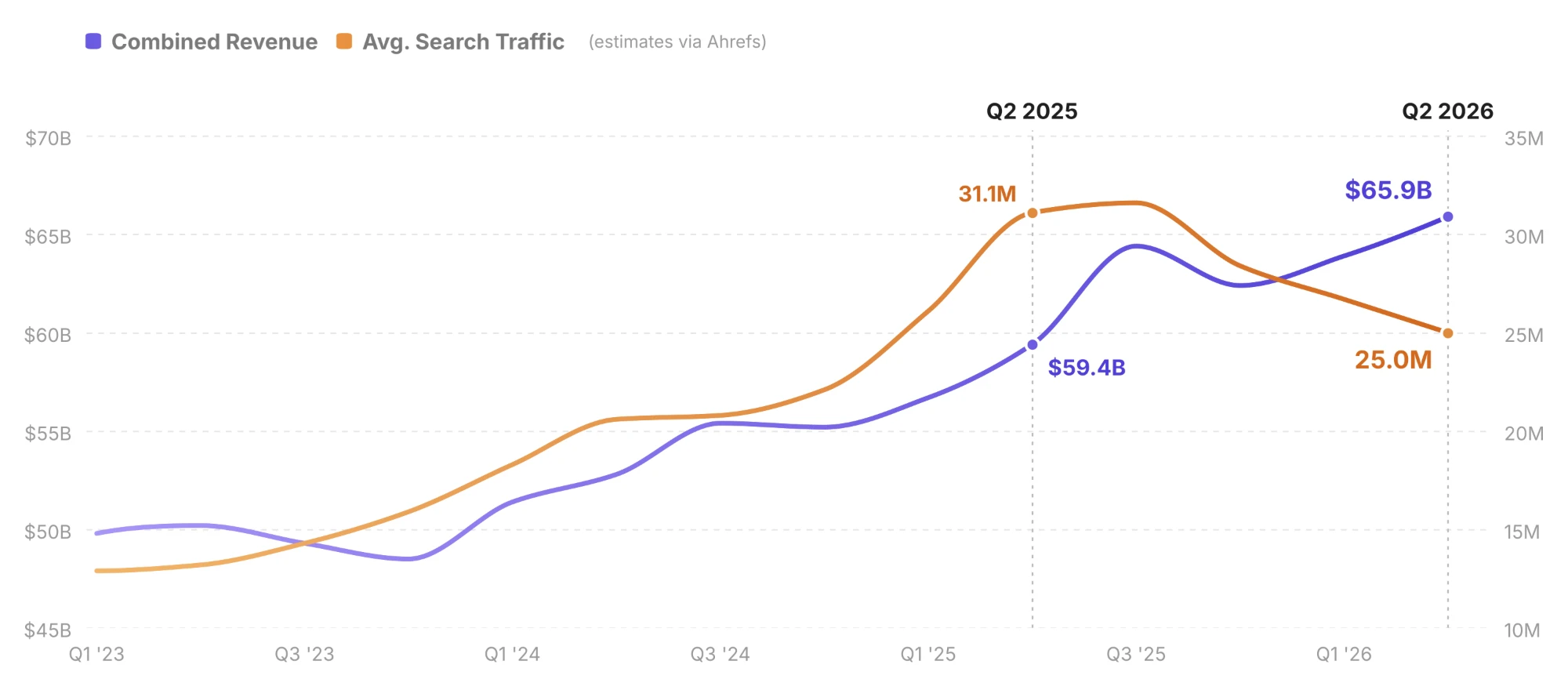
A fantastic Digital Goliath Revenue tracker from Detailed shows that there has been a decline in Google organic search traffic. But revenue continues to grow.
It follows 100 digital-first public companies, alongside their organic search traffic. Their combined revenue reached $65.92bn in Q2 2026, up 12.1% year on year.
However, what is interesting is that the revenue tracker uncovers a trend.
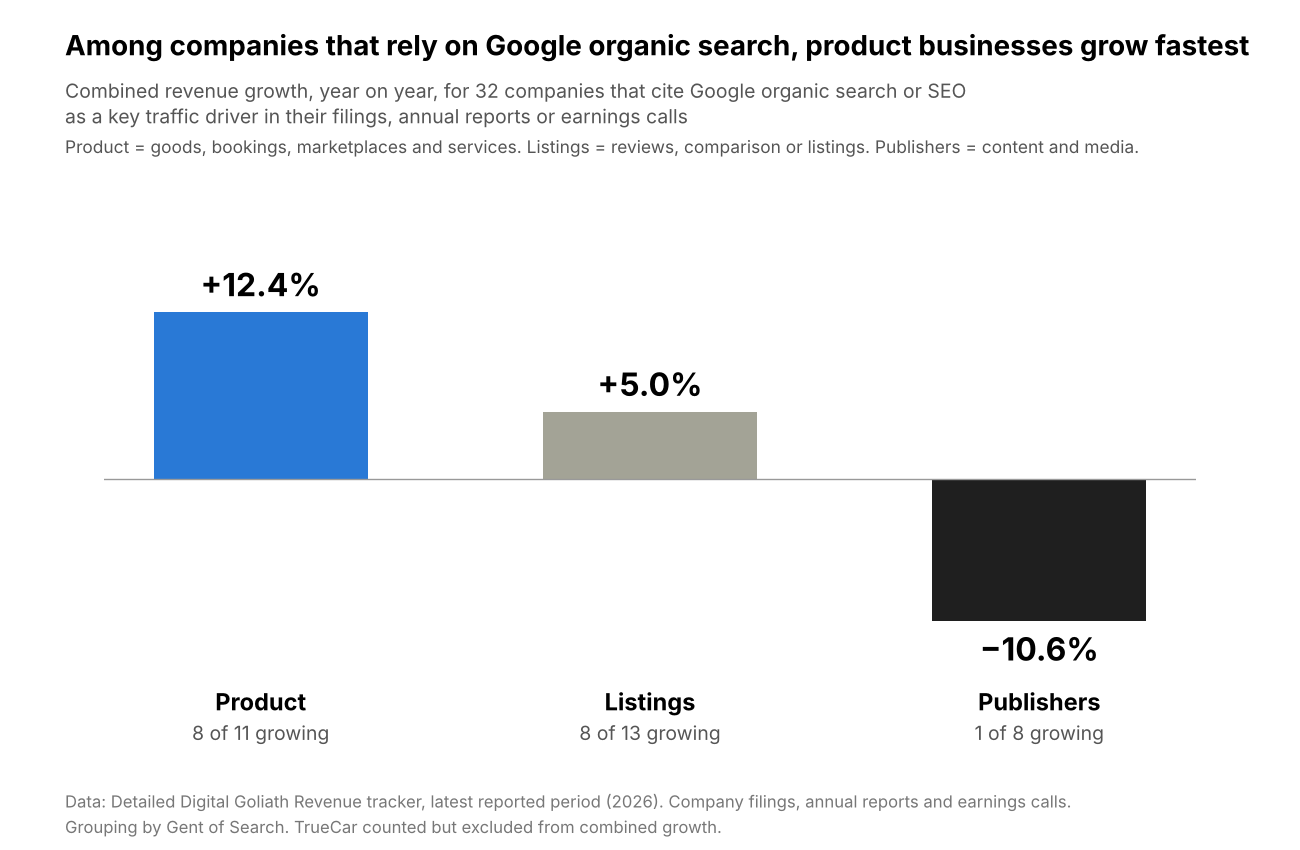
If you analyse the top 100 companies and identify which ones cite Google organic search as a key traffic driver. Then check the filings and reports for the companies listed. 32 name Google organic search or SEO as a key traffic driver.
Grouping each company into a specific category revealed some interesting trends:
- Listing sites grew revenue by 5.0%, and 8 of 13 are growing.
- Publishers did worse. Only 1 of 8 grew, and together they shrank ~10.6%.
- Product companies grew revenue by 12.4% year on year, and 8 of 11 are growing.
The ones still growing capture buying intent (revenue change year on year, from Detailed):
- Airbnb (+18.9%): told investors in its first 10-K that it focuses on unpaid channels such as SEO.
- The RealReal (+18.8%): relies on search engines and major mobile app stores as important marketing channels.
- Expedia (+11.9%): generates a significant portion of its traffic from search engines like Google, through paid keywords and organic search.
- NerdWallet (+11.4%): says it is dependent on internet search engines, primarily Google, to drive traffic.
- Wayfair (+10.3%): gets a significant amount of traffic from search engines, and now optimises for AI search platforms too.
- CarGurus (+8.1%): relies on high organic rankings to bring car buyers to its websites.
The companies shrinking rely on search too. But they answer questions Google now answers itself. Tripadvisor (−21.1%) names AI Overviews displacing top-ranked links as a risk. Ziff Davis (−20.5%) saw its organic Google referrals fall about 37% in Q3 2026.
Product companies feel it too when their searches look like questions. LegalZoom (+2.6%) relies on both algorithmic and paid search listings to drive traffic. Its business formations fell 5% in Q2 2026 as AI search summaries changed how people find it.
Google organic search still drives revenue. Just not for every type of business.
What does this mean for your business?
Investing in the SEO channel still provides opportunities to drive revenue for the right business.
Businesses that sell things online are still growing their revenue from Google. People who search often want to buy.
If you sell a product or service, showing up in Google puts you in front of those buyers. Google might not be the right channel to drive revenue if your website only answers questions, adds no unique perspective, and relies on ad revenue.
2. Google organic search sends more traffic than AI
Google doesn't just drive revenue, it also drives the most traffic.
Google is still the biggest source of traffic to most websites. AI tools are growing, but from a tiny base.
Recent studies show that Google organic search still sends more referral visits:
- SE Ranking studied 101,574 websites between January and April 2026. Organic search drove 42.75% of their traffic. AI platforms drove 0.32%. That's roughly 134 visits from search for every one visit from AI.
- Conductor's 2026 AEO / GEO Benchmarks Report is the most generous to AI I've found. Across 13,770 enterprise domains, organic search drove over 33% of sessions, against 1.08% from AI referrals.
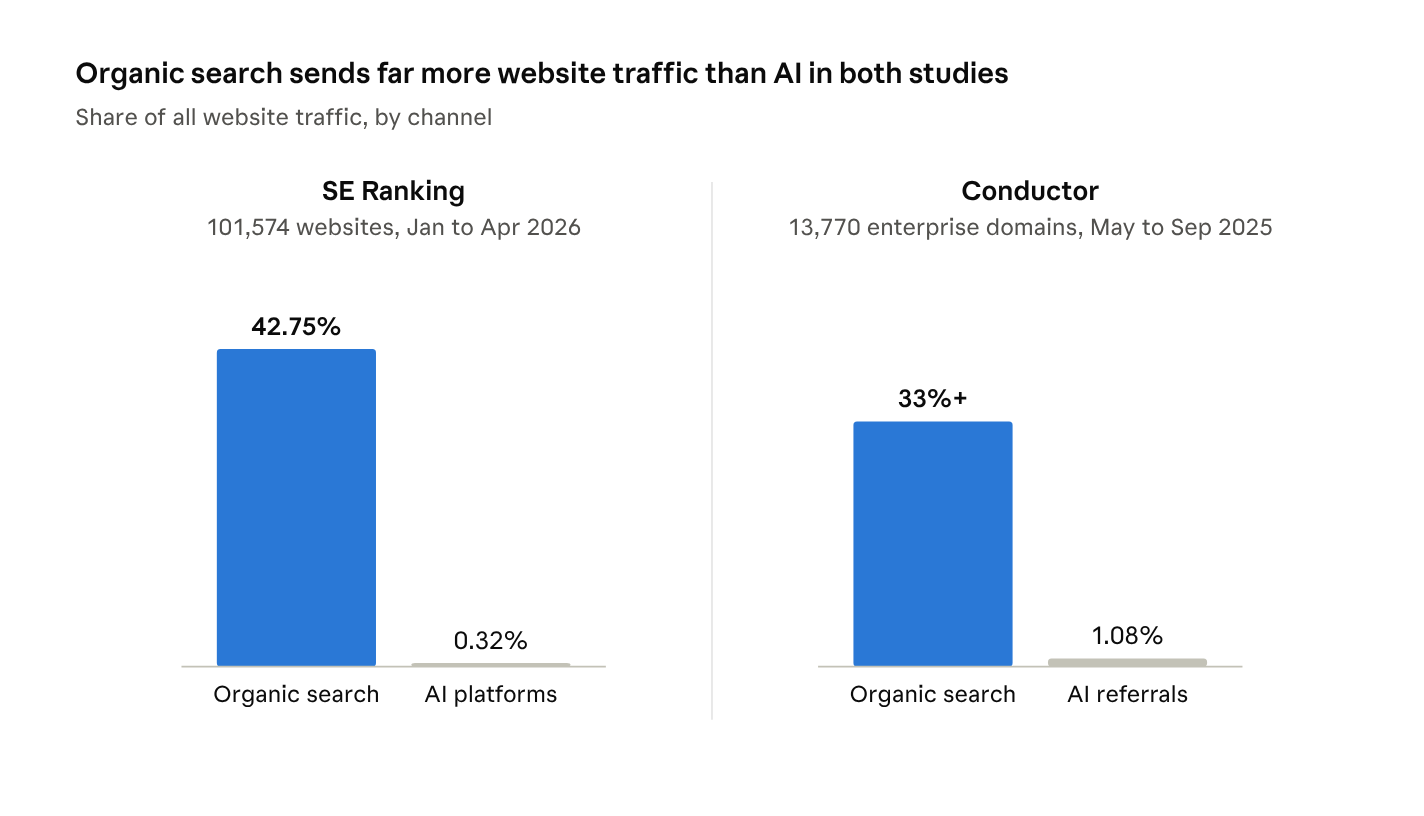
AI traffic is growing fast. But if you want visitors, Google is still your biggest traffic source.
What does this mean for your business?
Google sends roughly 134 visitors for every one from AI tools.
If you cut your marketing, developer or product budget to chase AI Search it means you’re risking your biggest source of new customers.
The SEO channel still offers the best opportunity to drive more customers to your website.
3. Google search volume is growing
Total search volume (searches per year) is growing.
SparkToro's analysis of Datos clickstream data found Google searches grew 21.64% from 2023 to 2024. Google itself now says it handles more than 5 trillion searches a year.
That's roughly 14 billion a day globally.
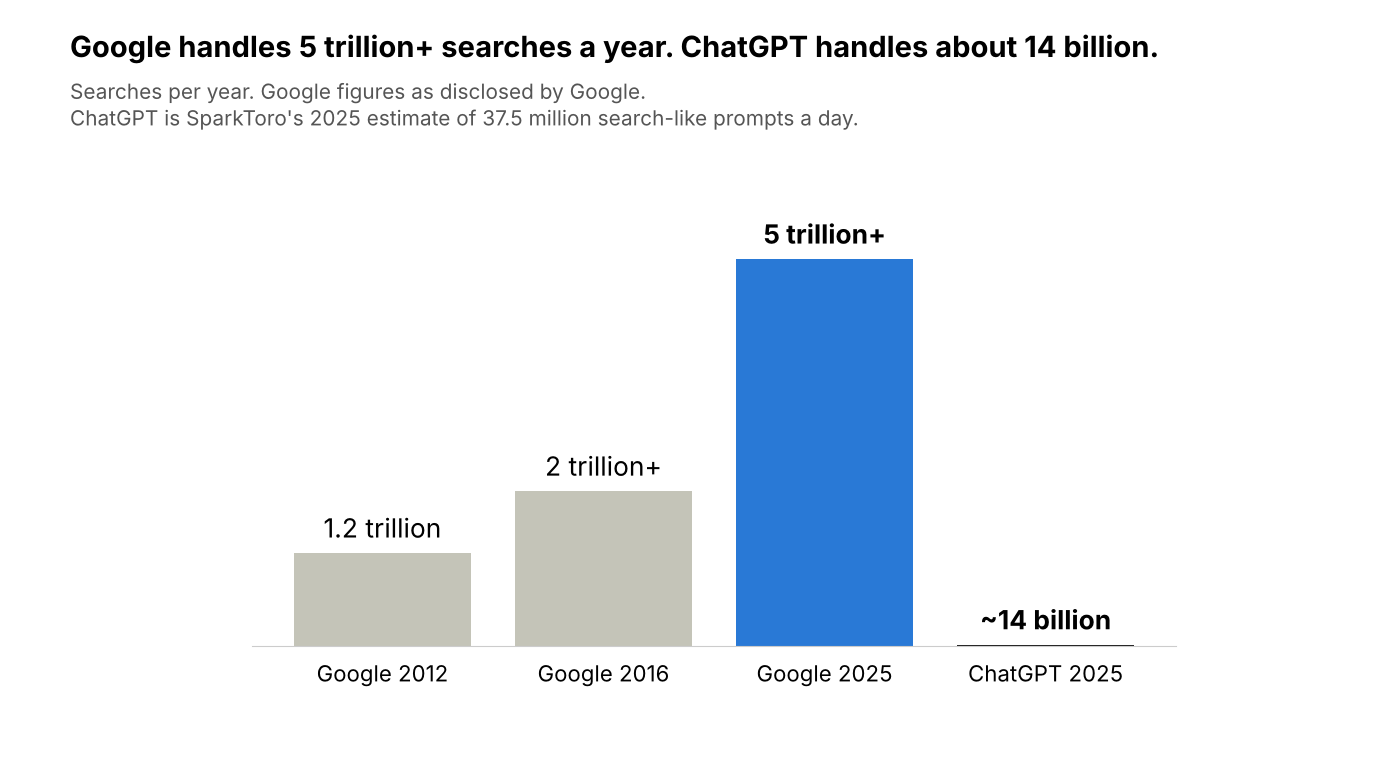
According to SparkToro’s research that puts Google at roughly 373 times the search volume of ChatGPT. ChatGPT sits on a similar scale to Pinterest (around 20 million a day) and about a third the size of DuckDuckGo (around 108 million a day).
People aren't searching less. They're searching more.
What does this mean for your business?
More searches every year means more chances for customers to find you.
The market isn't shrinking. It's getting bigger each year. Yes, Google Search traffic is declining but your audience hasn’t gone anywhere. They are still searching for answers, services and products.
4. Google still dominates the search market
People don’t just search on Google. They search on Amazon, YouTube, Reddit and inside AI tools.
SparkToro worked with Datos to look at the whole picture. Using Datos panel data, it compared searches across 41 websites with significant search activity, not only traditional search engines and AI prompts.
Google still dominates, by a country mile.
In Q4 2025, Google handled 73.7% of US desktop searches across those 41 sites. All AI tools combined handled 3.2%.
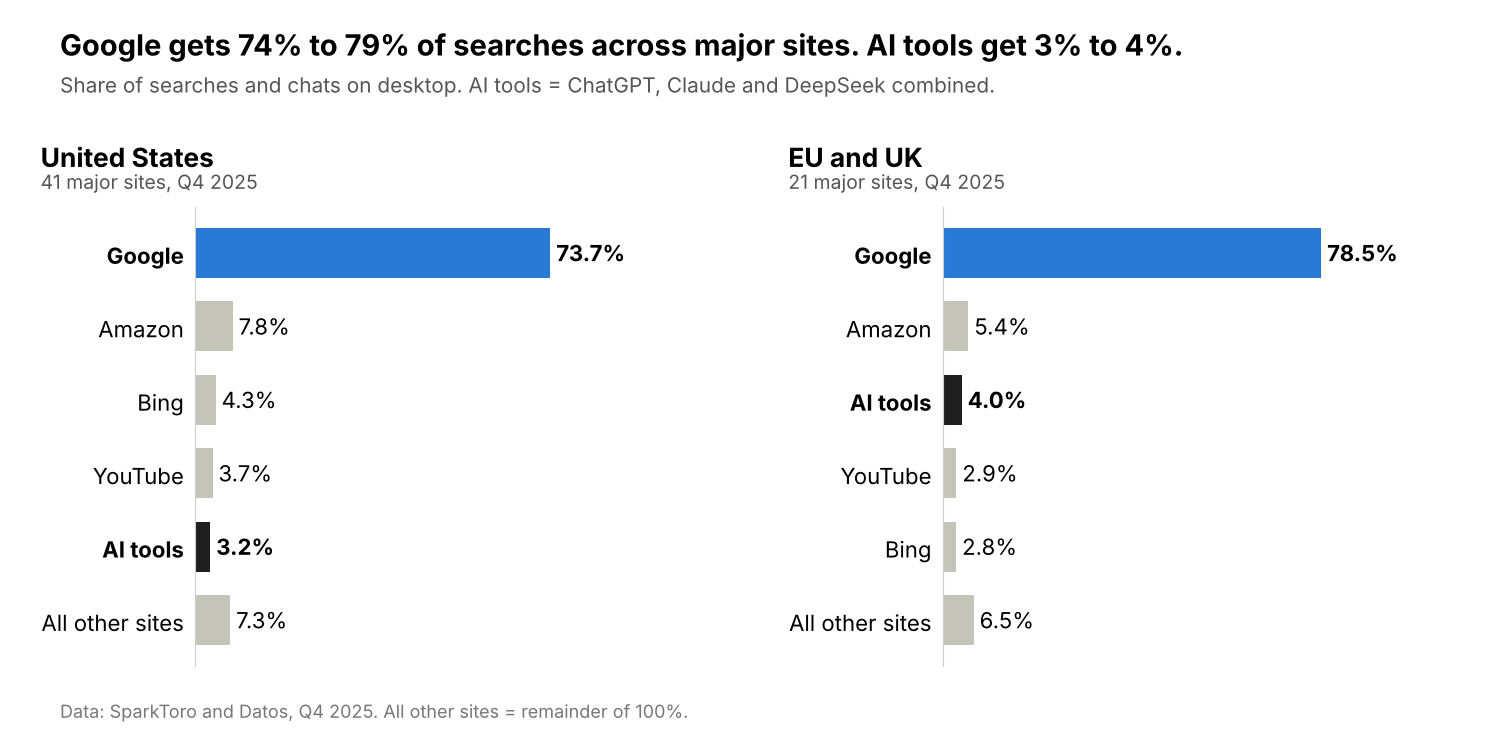
The data did show that Google did lose market share.
Its US share fell 3.5 points during 2025 (about 2 points in the EU and UK). But that share mostly went to Amazon, Bing and YouTube, not to ChatGPT, according to SparkToro.
On the traditional measure, Google's position looks even stronger. StatCounter puts its worldwide search market share at 91% in October 2026.
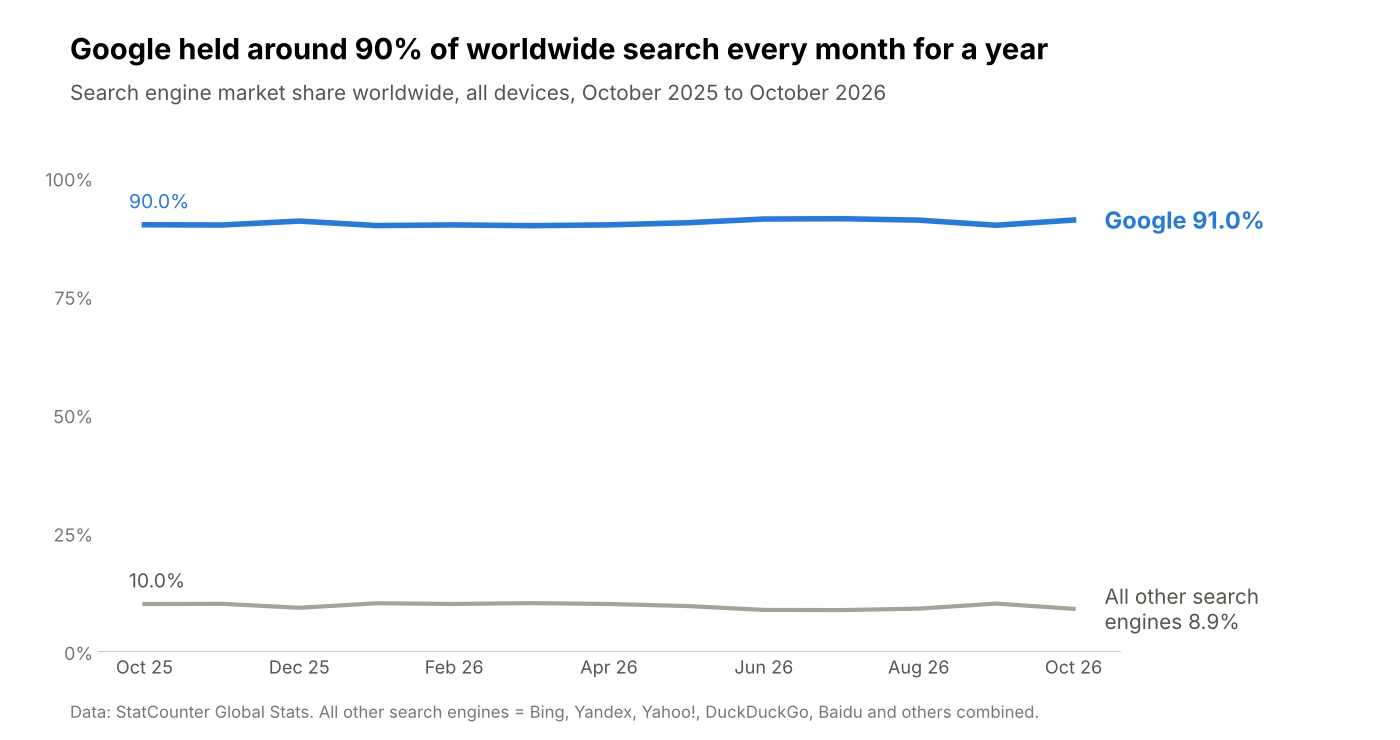
Both datasets point to the same trend: Google market share is still dominant even if it loses a few points.
What does this mean for your business?
90% of searches happen in Google Search. Even in the age of AI.
If you only invest in AI Search and not invest in Google Search, you’re missing out on the most dominant search engine in the market.
Any business with a limited budget can only focus on one place, then focus on Google Search. That is where most of your customers are looking. Being visible in Google covers the biggest share of the market with one channel.
5. Google's AI search sends better clicks
Evidence suggests that Google Search AI features might send higher quality clicks.
In August 2025, Liz Reid (Head of Google Search) said total organic clicks from Google to websites were relatively stable year-on-year. More importantly, she said average click quality had gone up. Google now sends slightly more quality clicks to websites than it did a year earlier.
Reid linked this to AI Overviews and AI Mode.
People are asking longer, more detailed questions. And AI Overviews show more links on the page, which gives more websites a chance to be clicked. But Google is marking its own homework.
What's interesting is that there is evidence that this is true.
In August 2026, Google launched a setting that lets sites opt out of its AI search features (AI Overviews and AI Mode) without leaving regular search.
Cyrus Shepard tested it on the Zyppy website:
- 1 September 2026: opted out of Google's AI search features for 28 days
- 29 September 2026: opted back in for another 28 days
Within an hour of opting out, Zyppy's AI search impressions dropped to zero. Its clicks from Google fell with them.
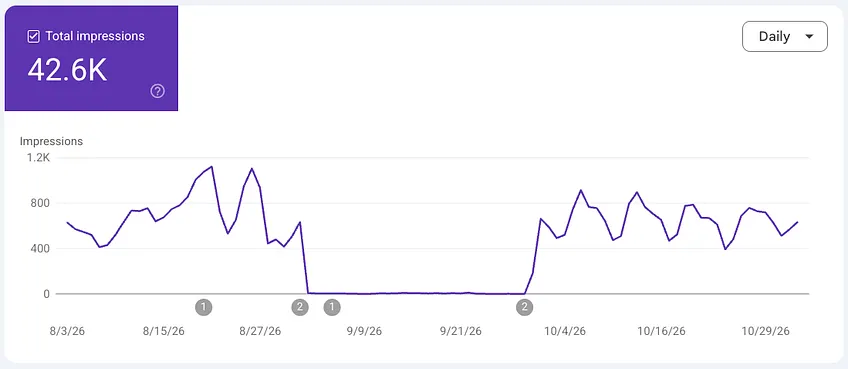
The reason is the click-through rate.
AI search features made up about 10% of Zyppy's search impressions. But they earned a click-through rate of about 0.9%, against 0.4% for the site's search results overall.
That's more than double. So 10% of impressions drove about 21% of all search clicks.
There was a halo effect too. When Zyppy appeared in AI Overviews, its regular organic results earned about 2% more clicks. Add that on, and Google's AI features drove about 23% of Zyppy's search clicks.
AI search isn't only taking clicks away. For Zyppy, it was sending the best ones.
What does this mean for your business?
Investing in SEO to help appear on AI features might help drive higher quality clicks.
A lot of industries focus on the decline in SEO clicks since AI features have been released. But evidence suggests that Google's AI features send higher quality clicks to your website.
Investing in your SEO channel helps your business get featured in those answers. That puts you in front of people at the top of the page. And can help drive better quality clicks to your website.
6. Google's AI features help influence users decisions
Judge a channel only by traffic and you'll miss most of what it does.
Studies show that AI tools send very little traffic, but many in the industry have reported that AI search sends a lot of users who are ready to convert. This is because of the conversational nature of AI search.
Below are case studies of websites that have seen conversions due to AI search:
- Ahrefs: AI search was 0.5% of its visitors but drove 12.1% of its signups. Those visitors converted 23 times better than traditional organic search visitors.
- Semrush: the average AI search visitor is worth 4.4 times a traditional organic search visitor, based on conversion rate. Semrush's explanation is that AI visitors have likely already compared their options before they arrive.
- Seer Interactive: for one B2B software client, ChatGPT visitors converted at 15.9%, against 1.76% for Google organic. That's about 9 times higher. ChatGPT was only 0.07% of the client's organic sessions.
- Microsoft Clarity: across 1,200+ publisher and news sites, AI visitors signed up at 1.66%, against 0.15% from search. AI referrals were still under 1% of traffic.
- Visibility Labs: across 94 ecommerce brands in 2025, ChatGPT traffic converted 31% higher than non-branded organic search (1.81% vs 1.39%). But it drove just 1.5% of organic revenue.
- Adobe: over the 2025 holiday season, AI referrals to US retail sites converted 31% more than other traffic sources. In January 2025, the same traffic was 49% less likely to convert.
The trend is clear: AI search warms up leads, so they arrive ready to convert.
People do their research and make their decisions inside the AI answer. And as the case studies show, ChatGPT is often cited as the biggest driver.
But Google is the biggest influencer, including in AI search.
Why?
Because the largest AI search product isn't ChatGPT. It's Google’s AI features on the largest search engine.
- Reach: AI Overviews have more than 2.5 billion monthly users, and AI Mode passed 1 billion within a year of launch. For comparison, ChatGPT has about 1.2 billion weekly users, according to OpenAI (September 2026). OpenAI doesn't publish a monthly figure.
- Coverage: AI Overviews appeared in 86.7% of Google searches in Peec AI's study of 500,000 prompts in April 2026, up from 56.9% in 2025.
- Overlap: between March and May 2026, 461 million of ChatGPT's 494 million users (95%) also used Google, according to Similarweb.
Google doesn't just send referral traffic, it helps influence decisions through AI features that are used by billions of users each month.
What does this mean for your business?
AI search helps warm up customers to your brand by being shortlisted.
As a result, customers make up their minds before they visit a website. Many believe ChatGPT is the biggest AI search driver, but data shows that Google's AI features reach billions of people every month.
Investing in SEO can help your business show up in those AI features. Which means you're on the shortlist before a customer ever visits a competitor.
7. Google is the final destination people trust
People don't move in a straight line from problem to purchase.
Google's own "messy middle" research describes loops of exploring and evaluating across lots of platforms. People start their journeys in lots of places: YouTube, Amazon, Reddit, TikTok, ChatGPT.
But again and again, research shows they come back to Google to confirm their answers.
The traffic data to Google.com confirms this: Monthly visits to Google Search have 3x in the last decade.
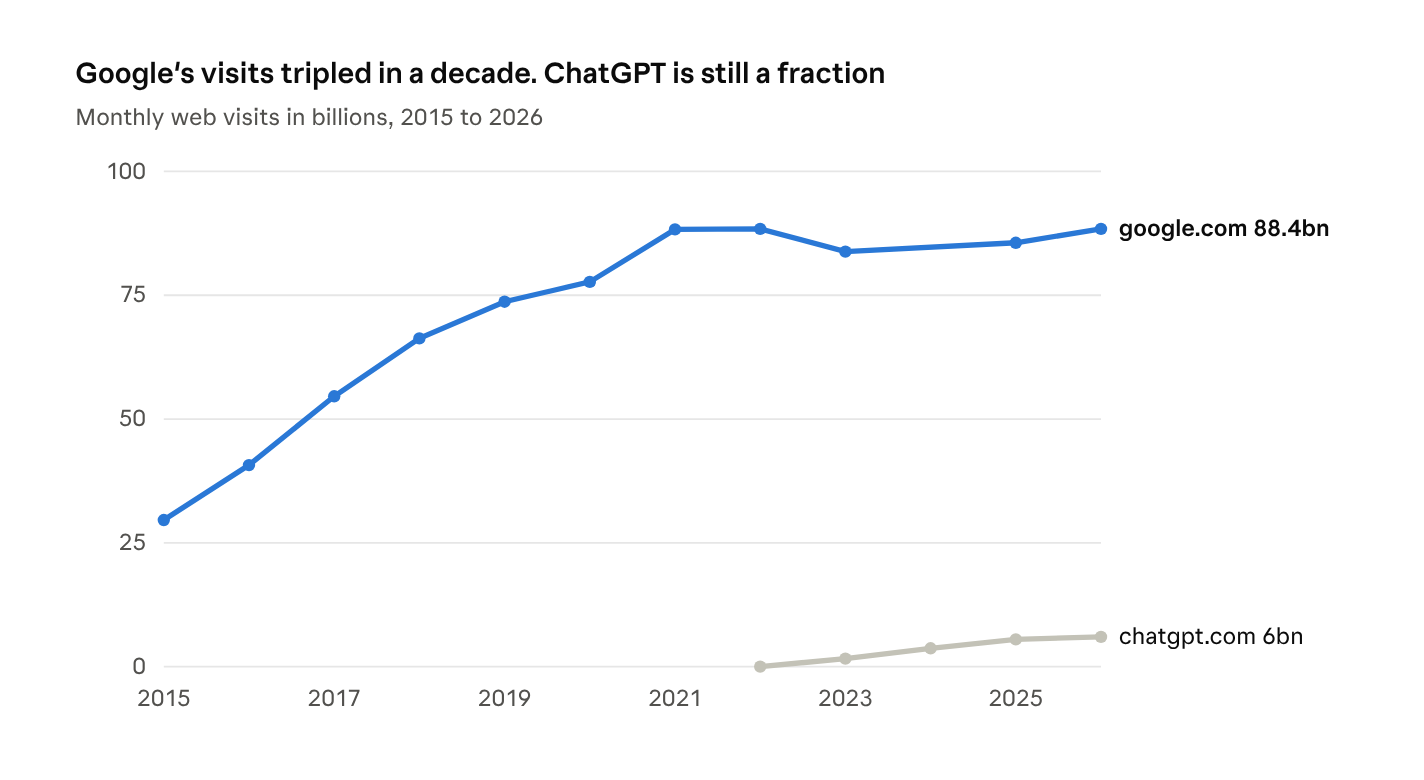
SparkToro's research points to four reasons why.
- Google is a habit. Over 95% of Americans use a traditional search engine every month. That figure has dropped by less than 1% in two and a half years. Heavy Google use (10+ times a month) actually rose, from 84% to 87%. Over the same period, monthly AI tool use grew from 8% to 38%.
- AI creates more searches, not fewer. In the same post, Fishkin cites Semrush data showing that when people start using ChatGPT, their Google searches go up. And they stay higher months later. AI answers raise new questions, and people take those questions to Google.
- Google is the doorway to everything else. People often reach YouTube, Reddit, Amazon and Wikipedia through a Google search. In Q1 2026, those were four of the top five sites people visited straight after searching. Even when the journey ends somewhere else, it often passes through Google.
- Search captures demand created elsewhere. As section 6 showed, search captures demand, public evidence creates it. People discover brands on social, in newsletters, in communities and in AI answers. Then they search for them. Across the top 5,000 websites, Google alone accounts for about a quarter of all visits. Search is concentrated, while influence is fragmented.
Yes, you need to invest in appearing on other platforms to influence customers. However, you can't win every platform people use to discover you. But you can make sure you're there when they go to Google to check.
Wherever the journey starts, people end up coming back to Google Search.
What does this mean for your business?
Customers discover you in lots of places online. But they check Google before they decide.
If you don't show up when they search for your name or product in Google Search, you can lose a sale you already earned somewhere else.
Investing in the SEO channel can help you drive sales you've already earned.
Summary: Why Invest in SEO
Let's quickly summarise why SEO is worth investing in:
- SEO still drives revenue. The 100 digital-first companies Detailed tracks grew revenue 12.1% year on year, to $65.92bn. Product businesses that rely on Google grew fastest, at 12.4%. If you sell something, SEO puts you in front of people ready to buy.
- Google sends the traffic. Organic search drives 33% to 43% of website visits. AI drives about 1%. Cut SEO and you cut your biggest source of organic search visitors.
- Search is growing. Google handles more than 5 trillion searches a year, over five times as many as in 2012. More searches means more chances for customers to find you.
- Google dominates search. Google holds 73.7% of US desktop searches. AI tools hold 3.2%. If you can only invest in one channel, it's where most of your customers are looking.
- Google's AI sends better clicks. For Zyppy, Google's AI features were 10% of search impressions but drove 23% of search clicks. SEO helps you get featured in those answers, where the best clicks come from.
- Google influences decisions before the click. AI Overviews reach more than 2.5 billion people a month, more than ChatGPT's 1.2 billion weekly users. Show up there and you're on the shortlist before customers visit a competitor.
- People keep coming back. Over 95% of Americans use a traditional search engine every month. Wherever customers discover you, they check Google before they decide.
SEO isn't dead. Google is still where people search, and where the money is.
